Category Archives: FYI

Sequoias and Redwoods Are Not the Same Trees

Standard

One of the most frequent questions I am asked in the line of duty (meaning when I collect money in the parking lot) is What is the difference between a sequoia and a redwood? Related confusion is exhibited when visitors refer to the trees they are about to see/have just seen as “redwoods” or when people tell me they saw sequoias north of San Francisco. I feel it is my duty to correct such mistakes. The company I work for may see me as nothing more than a money collector, but I see myself as an educator.

When I visited Sequoia National Park, I bought an oversize postcard explaining the differences between giant sequoias trees and coast redwoods. The postcard’s copyright belongs to the Sequoia Natural History Association and has a date of 2009. I bought the postcard so I’d have something I could show folks in order to alleviate their sequoia/redwood confusion. As a service to my readers, I will summarize the information on the card (as well as information on a handout I was given by a Forest Service employee) and alleviate any confusion you may have regarding these trees.

The trees are in the same family, but we know they are not the same because they have different scientific names. The scientific name of the giant sequoia is sequoiadendron giganteum The scientific name of the coast redwood is sequoia sempervirens.

The easiest way to tall a giant sequoia from a coast redwood is location. While both grow naturally in California, coast redwoods live on the northern coast of California, and giants sequoias live on the Western slope of the Sierra Nevada mountains between 5,000 and 7,000 feet elevation.

(Instead of referring to where trees live, in the case of the giant sequoias, we must talk about where the trees occur naturally and/or reproduce. While reading the book Giant Sequoias by  R.J. Hartesveldt; H.T. Harvey; H.S. Shellhammer; and R.E. Stecker, I learned giant sequoias live throughout Europe, although the trees currently living there did not occur naturally—people planted the seeds the trees grew from—and the trees are not reproducing naturally there. I am unsure if coast redwoods grow—naturally or otherwise—anywhere other than the coast of California.)

Another difference between coast redwoods and giant sequoias is size. Coast redwoods are taller than giant sequoias. In fact, coast redwoods are the tallest trees in the world, reaching heights up to 367.8 feet. The tallest giant sequoia is “only” 311 feet. Giant sequoias, however, are wider, with widths up to 40 feet, compared to the widths of coast redwoods of up to 22 feet. Giant sequoias are the largest living trees; they contain a greater volume of wood than any other trees, due to their height and great width. Giant sequoias weigh up to 2.7 million pounds, while coast redwoods weigh up to 1.6 million pounds. Part of the reason for the weight and volume difference is the thickness of the bark of the trees. The bark of giant sequoias can be up to 31 inches thick, while the bark of coast redwoods can be up to 12 inches thick.

Both giant sequoias and coast redwoods reproduce by seeds, although coast redwoods can also reproduce by sprout. (Giant sequoias don’t reproduce by sprout.) Coast redwoods have seeds that look like tomato seeds, while giant sequoia seeds look like oat flakes. Both trees produce cones in which their seeds grow, but the cones are of different sizes. The cones of giant sequoia trees are about the size of a chicken’s egg, while the cones of coast redwoods are the size of an olive.

Giant sequoias live longer than redwoods. The oldest giant sequoia is thought to be 3,200 years old, while the oldest coast redwood is believed to be 2,000 years old.

Finally, all giant sequoias are protected by law from being harvested, while coast redwoods can legally be harvested and used for lumber.

So now you know the difference(s) between coast redwoods and giant sequoias. My work today is done.

I took this photo of a giant sequoia. Unfortunately, when I visited the coast redwoods, I didn't have a camera, so I don't have a photo of one of those magnificent trees to share.

I took this photo of a giant sequoia. Unfortunately, when I visited the coast redwoods, I didn’t have a camera, so I don’t have a photo of one of those magnificent trees to share.

Smokey Bear

Standard

IMG_2973

I got this Smokey Bear bandana at a small-town thrift store for only $1! It was still in the plastic packaging.
(The same bandana is going for $3.99 and up on Ebay: http://www.ebay.com/sch/i.html?_from=R40&_sacat=0&_nkw=smokey+bear+bandana&_sop=15.)

My friend Madame Chile had a Smokey Bear bandana. I can’t remember if it was just like this one. In any case, I coveted it. Now I can sin no more because I have my own Smokey Bear bandana.

These following two photos show the other words on the bandana, as well as the little campfire graphic:

IMG_2976     IMG_2978

Here’s some history of Smokey Bear, according to http://www.smokeybear.com/kids/assetframe.asp?id=7&html=1.

Smokey Bear was born on August 9, 1944, when the U.S. Forest Service and the Ad Council agreed that a fictional bear named Smokey would be the symbol for their joint effort to promote forest fire prevention.

Artist Albert Staehle was asked to paint the first poster of Smokey Bear. It depicted a bear pouring a bucket of water on a campfire and saying “Care will prevent 9 out of 10 fires.” Smokey Bear soon became very popular as his image appeared on a variety of forest fire prevention materials. In 1947, his slogan became the familiar “Only YOU Can Prevent Forest Fires!”

Then in the spring of 1950, in the Capitan Mountains of New Mexico, a young bear cub found himself caught in a burning forest. He took refuge in a tree, and while managing to stay alive was left badly burned. The firefighters who retrieved him were so moved by his bravery, they named him Smokey.

News about this real bear named Smokey spread across the Nation, and he was soon given a new home at the National Zoo in Washington, D.C. The living symbol of Smokey Bear, he played an important role in spreading messages of wildfire prevention and forest conservation. Smokey died in 1976 and was returned to Capitan, New Mexico, where he is buried in the State Historical Park.

IMG_2977

Staying Warm

Standard

My #1 way of staying warm while living in my van is to go somewhere warmer when the weather gets colder. For example, in 2014, I left Northern New Mexico at the end of October and went to Southern New Mexico, where I stayed for November and December. In January 2015, I went to Arizona and stayed in various places in that state until I went to the California mountains at the end of April.

People often ask me if I stay warm enough in the van at night. Staying warm at night is not a problem. My bed is raised about two feet, so my body heat isn’t lost to the floor, and I have storage space. I sleep on two layers of memory foam, which is notorious for making people hot. I wear long underwear and socks to sleep when I need to, as well as a hat if it’s particularly cold. I have plenty of blankets, including two sleeping bags and a knitted (crocheted?) blanket stored flat under the memory foam and on hand for any really cold situation.

My bed lies across the back of the van, up against the back doors. On the side opposite the back doors, I have a curtain (a sheet I paid $1 for at a thrift store strung on a bungee cord) that I can pull for privacy. I found out early on that the curtain holds in quite a bit of my body heat. In hot weather, I often have to leave the curtain open at night so I don’t get warmly uncomfortable. When it’s cold out, I’m glad the curtain holds in the warmth.

Once I’m in bed, I’m warm. Sometimes I even get too warm and have to push the covers down for a while so I can cool off in the chilly air.

The problem in cold weather is getting out of the bed, either to get dressed and get out of the van or to move around inside the van (to tidy up or to cook, for example). Sometimes it’s too cold inside even to sit up in bed to read or write.

While I was in Southern New Mexico, temperatures were getting down in the low 30s at night. I researched how other rubber tramps stay warm in their vehicles.

One idea I found on a couple of websites was burning a candle. Candles (supposedly) raise interior temperature in a vehicle by 10 degrees. Of course, one must be careful with the open flame. (I have a lot of fabric in my van—curtains, rugs, blankets, clothing strewn about—so I have to be particularly careful not to catch everything I own on fire.) One must also be careful not to let the candle use up all the oxygen in one’s enclosed space, which can lead to death. This means one must leave a window open at least a crack when using a candle inside a vehicle.

I wondered if leaving the window open—even just a crack—negated any heat produced by a lit candle. However, I was willing to give it a try, so I walked down to one of the locally owned gift shops and bought a small (overpriced, artificially scented) candle. I tried burning the candle a couple of mornings. I (thankfully) did not catch anything on fire, but I didn’t notice feeling any warmer when the candle was burning. I decided the candle experiment was a failure.

At the time, I was staying in an RV park with electrical hookups. I considered going to Stuff-Mart and buying a small electric heater. (I think they run $15-$20.) I decided not to do that because I very seldom stay in my van in places with electrical hookups. Even a small heater would take up precious storage space when not in use, and I wouldn’t use it enough to justify having it.

The last week I was in Southern New Mexico (the week between Christmas and New Year’s Eve), the temperature dropped to 28 degrees. I was lucky because I had gotten a house and pet sitting job. I stayed in a lovely warm house with a nice cat and a nice dog, and I didn’t have to think about heating the van.

During my internet research, I’d read a bit about portable propane heaters. Several van dwellers I read about swore by them. I didn’t rush out to buy one because #1 they’re a little pricey and #2 burning propane in the van causes the same concerns as burning candles.

At the Rubber Tramp Rendezvous (RTR), I talked to people who used propane heaters in their vehicles.

The Divine Miss M had a Mr. Heater brand Portable Buddy heater, which was a popular choice among folks at the RTR. (I don’t know why exactly, maybe I heard someone else refer to the heaters this way, but I call this type of heater Mr. Buddy.) Miss M loved hers, said it got her station wagon plenty warm, but did stress the absolute necessity of leaving a window open a crack when using the heater inside. She assured me that the heater produced enough heat to overcome the cold let in through the partially open window.

I stored the info in my brain file for future reference. I wasn’t in the market for a heater, although on some chilly mornings in the Arizona desert, I would have welcomed a few minutes of concentrated warmth.

At one of the very last group gatherings at the RTR, during announcements, a man said he had a brand new Mr. Buddy heater for sale. He said he’d just bought it from Amazon.com for $69 ($20 less than normal price, I was told) but had found a heater he liked better at the Big Tent. He wanted to sell the heater for $69, plus another $20 or $30 for the supplies to hook it up to a large propane tank. When I went to talk to the guy selling the heater and told  him I was interested in the heater but not the accessories because I didn’t have a large propane tank, there was a grumpy old man already looking at the items. The old man snapped at me that I needed a larger propane tank because it was cheaper to buy propane that way. Rather than snap back at the old coot elder, I just told the guy with the items for sale that the old guy could buy it since he was there first.

Before I could get back to my van, the seller had come after me to say the old guy didn’t want the heater and I could have it for the $69 he’d spend on it. I bought it.

I tried it out a couple of times before I left the RTR (thanks to the bottle of propane Miss M gave me to use with it). It worked great, warmed the van quickly. It was just enough heat to get me motivated to get out of bed and get dressed. I told Miss M that Mr. Buddy was my new boyfriend!

Then I went back to the City and didn’t stay in my van for upwards of three months. Mr. Buddy was packed in a plastic storage tub, and I didn’t think much about him. Until…

It’s cold in the California mountains, even in May. Seems like the temperature starts dropping around 4:30 in the afternoon (16:30, military time) and doesn’t warm up again until the next day around noon. Sleeping is fine. Actually, I sleep better when it’s chilly and I can snuggle under piles of blankets, so sleeping is excellent. It’s the between times that are trying.

I get up early to do a check of the campground, sweep the restrooms, make sure there’s enough toilet paper. I decided I needed the warm motivation only Mr. Buddy can provide, so I’d already planned to unpack him when I heard the high the next day was expected to be only 41 degrees, and there was a possibility of snow. I pulled Mr. Buddy and his propane bottle out of the plastic crate and fired him up before I crawled into bed. In about ten minutes, the van was toasty.

When I got up in the morning to pee, I fired him up again until I warmed up. Oh yes, Mr. Buddy and I are sure to have a long and happy relationship.
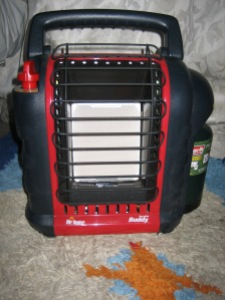
I took this photo of my boyfriend Mr. Buddy in my van.

I took this photo of my boyfriend, Mr. Buddy, in my van. The propane bottle fits right in on the side.

Safety Precautions I Follow with Mr. Buddy

#1 I open at least one window at least a crack before igniting Mr. Buddy’s flame.

#2 Because there is an actual flame, I make sure no fabric is near Mr. Buddy’s front.

#3 I never leave him unattended. I DO NOT exit the van or go to sleep while Mr. Buddy is on.

#4 When I turn off Mr. Buddy, I unscrew and remove the propane bottle. Some people don’t do this, but I take this precaution so I know no propane is leaking.

While writing this post, I remembered another idea for getting/staying warm. I learned this one years ago from a New Englander in New Orleans. Drinking or eating something hot is a good way to warm up from the inside. However, when I’m cold first thing in the morning, I don’t necessarily want to crawl out of my warm bed to heat water for tea.

img_2813For my birthday, my host family gave me a Stanley thermos. It keeps water hot for a long time. I used it while working the essay scoring job so I’d have hot water for my lunch. I’d heat the water in the morning, put it in the thermos, and the water would still be hot enough at lunchtime to prepare noodle soup (ramen noodles and the like). One day I didn’t use the water for lunch, and the next morning (24 hours later) when I opened the bottle, the water was still very warm.

So this is my idea: Before I go to bed, I’ll boil water and put it in my Stanley bottle. I’ll put it next to my bed, along with my mug and a teabag. When I wake up in the morning, I’ll pour myself a cup of hot tea before I even get out of bed. Sounds lovely.


I did not receive any compensation for the endorsements of the products in this post. I wrote this post after I already owned the products. I just like ’em, and I think my readers might like them too.

If you click on either of the photos below, you can shop on Amazon through my affiliate link. If you do your normal Amazon shopping through my affiliate link, I receive a commission from your purchases at no cost to you!

[amazon template=image&asin=B0000643KA]

[amazon template=image&asin=B002G51BZU]

Power Position

Standard

Back in February, I was a juror in a mock trial for an audience of corporate defense attorneys. The guy who organized the mock trial told us one thing that has stuck with me and will maybe actually help me one day.

The lawyer alleged that holding our bodies in different positions will affect our state of mind. For example, if we sit with our shoulders slumped and our heads down, chemical changes in our bodies will make us feel less confident.

He told us what he does if he needs a client to feel more confident before s/he takes the witness stand. He sends the client somewhere private, like a restroom stall. He tells the client to stand with legs shoulder-width apart, head up, with arms over their heads (like they’ve just won something), hands in fists. He says standing like this for two minutes will raise a person’s testosterone levels and lower the person’s cortisol levels, which he says leads to increased confidence.

I did a little research as I was writing this post, and there is scientific evidence to back up this claim.

According to http://blog.ted.com/10-examples-of-how-power-posing-can-work-to-boost-your-confidence/,

Amy Cuddy, a social psychologist at Harvard Business School…,along with her collaborator Dana Carney of Berkeley, ran an experiment in which people were directed to adopt either high-power or low-power poses for two minutes…[T]here were physiological differences between the two groups, as shown by saliva samples. While high-power posers showed an 8% increase in testosterone, low-power posers had a 10% decrease in the hormone. Meanwhile, the inverse relationship happened with cortisol, the hormone related to stress. While high-power posers experienced a 25% decrease in cortisol levels, low-power posers had a 15% increase in their stress levels.

(If you got to the aforementioned website, you can see a fantastic video of a TED Talk that Amy Cuddy gave on how body language shapes who we are. She talks about body language not just conveying information to others, but how it also influences how we feel about ourselves. Her presentation is really awesome, and I totally recommend it.)

Next time you need to feel confident, try going somewhere and standing for two minutes as if you are already victorious. Let me know how it works out for you.


Fish Print

Standard

Yesterday a reader responded to the post “Inappropriate.” Here’s what the reader wrote:

I know this is about the romper, but I think the fish print thing is inappropriate. Where did they get these dead fish? Were they goldfish or were they trout? I doubt anyone was going to be eating these fish once they had paint all over them. Were they killed specifically for this project? If so, how? How many dead fish were there? Were they rinsing the fish off so the next person could change the paint color, or were all the fish prints using the same color paint? Was there an adult monitoring the hand washing of children after they’d touched dead fish?

I decided to give my response as a post instead of just adding a comment that might be missed by some readers. My response follows.

I will try to answer your questions about the fish prints and the fish involved. I don’t know the answers to all of your questions.

I don’t know where they got the dead fish. I assume they got the fish from the seafood section of a supermarket. I suppose the fish could have been donated by the person who caught them.

The fish were not goldfish. I don’t know if they were trout. (Are trout the flat ones?) To me, the fish looked like fish one would buy from the seafood department of a large supermarket, then take home to cook and eat. They were rather long (eight inches?) and kind of thin (two or three inches?)

I would not have wanted to eat the fish after the art project was over. Even if the paint were nontoxic and could have been totally washed off of the fish, by the time it was all over, I think the fish would have been off the ice for quite a while. I’d be afraid the fish had gone bad. The fish were being kept on ice between prints, and an adult was squeezing lemon over the fish and ice to help alleviate the rather fishy aroma in the room, but I don’t think eating them at the end of the day would have been a good idea.

Also, the fish would have been touched by a lot of people by the end of the day. Even if the fish weren’t spoiled, I don’t know if the people touching the fish had clean hands, so I don’t think I’d want to eat fish handled with possibly dirty hands. I don’t know if cooking fish eliminates dirty hand germs.

I did not see anyone washing hands before or after handling the fish. I did not notice an adult supervising hand washing. Of course, there could have been hand washing that I didn’t notice. I’m not saying that hands were not washed after fish touching, only that I did not notice hand washing.

I do not know if the fish were killed specifically for this art project. I assume they were killed for eating, but that is speculation.

I also cannot say how the fish were killed. I do not have that answer. Their heads were intact, so I don’t think they were bashed in the head, as some fisherpeople do. (I had a fisher friend who just let the fish she’d caught grow dormant in ice, then “cleaned” them while they were still alive.) I do not know how fish intended for consumption and sold at fish markets are killed.

I am trying to remember how many dead fish there were. I didn’t count them. I would estimate there were six to eight dead fish available for making fish prints.

I think the fish were being rinsed off between prints, but now I am unsure. I also think there were two or three paint colors to choose from, but I’m unsure about that too. Because the fish were going back into a tub of ice between prints, I think they were being rinsed between prints. I don’t remember the ice being mucky or colorful from paint being mixed in, which leads me to think the fish were rinsed between prints.

The theme of the other projects going on in the art room seemed to be of an Asian influence, possibly of a Japanese influence.

I did a Google search for “fish prints,” and found that this is indeed a Japanese technique, and it has a name. According to Wikipedia it is called “gyotaku”. The word is “Japanese 魚拓, from gyo ‘fish’ + taku ‘rubbing’.” This “is the traditional method of Japanese fish printing, dating from the mid-1800s. This form of nature printing may have been used by fishermen to record their catches, but has also become an artform on its own.”

I hope this answers all the reader’s questions. I’ll be happy to try to provide additional answers to additional questions.

It’s Mardi Gras, MotherF*%#er!

Standard

IMG_1792Today is Mardi Gras!

For those of you who don’t know, Mardi Gras is the French term for the time of celebration on the day before Ash Wednesday. The English term is Fat Tuesday. Ash Wednesday (in the Catholic church, at least…I don’t know much about other Christian faiths) is the beginning of Lent, a period of 40 days of fasting and penance prior to Easter. So the idea is that one goes out on Mardi Gras and has fun eating and drinking and doing all the decadent things one will then give up the next day for Lent.

The term “Mardi Gras” can also be used to describe the entire season starting on January 6th (also known as Twelfth Night or the Twelfth Day of Christmas) and ending at the stroke of midnight when Fat Tuesday becomes Ash Wednesday. This period of parades, King Cakes, and partying is also (and more accurately) known as Carnival season or Carnival time.

Sometimes people think that Mardi Gras day kicks off the Carnival season. That is absolutely wrong! If you arrive in New Orleans (or Rio, for that matter) on Mardi Gras day and think you are in for a few days of partying, you will be sorely disappointed. In New Orleans (in the 90s at least, but I suspect it’s still the case), when the clock struck midnight and it was officially Ash Wednesday, the cops would herd everyone out of the French Quarter streets. People could still hang out in bars, but the public partying was over.

So Mardi Gras is a day, (always the Tuesday before Ash Wednesday) and Carnival is a season. Got it? (I’m being technical here. The terms “Mardi Gras” and “Carnival” are in reality used interchangeably, but I think it’s important to know the distinction between the two.)

If you can’t be in New Orleans today, but you’re wondering what’s happening down on Bourbon Street, check out the Mardi Gras EarthCam. The camera is mounted on the corner of St. Peter and Bourbon Streets. When I checked it out on Saturday (2-14-15) morning, it was all still pretty tame, but folks were strolling past, and there was a Lucky Dog vendor across the street. (If you don’t know what a Lucky Dog is, look here: http://www.luckydogs.us/ or read A Confederacy of Dunces by John Kennedy Toole.)

I mentioned King Cakes, and probably not everyone reading this knows what they are. King Cakes are pastries eaten exclusively during Carnival season. If you make your own, you can eat one whenever you want, I suppose, but that would be sort of like eating fruitcake in June just because you like the taste. And perhaps in this age of internet ordering it may be possible to buy a King Cake at any time of the year. But I’m telling ya, you’re flying in the face of the spirit of Mardi Gras to eat them outside of Carnival season.

Traditionally, King Cakes are kind of like coffee cakes with a cinnamon-y filling and decorated with (sometimes) white icing and (always) purple, green, and gold sugar sprinkles. (I must admit, at the risk of losing any New Orleans cred I may have left, I have never much enjoyed traditional King Cakes. They’re too dry and not sweet enough for me.) Of course, these days, one can buy King Cakes with all sorts of delicious fruit and/or cream cheese fillings. (These newfangled King Cakes I like quite a bit.) One of my family members makes King Cakes with frozen crescent rolls for the dough, then fills them with cream cheese and pie filling. I know they’re not traditional, but they are sooooo delicious.

The really important part of a King Cake is the baby. The King Cake baby is made of plastic and is tucked into the cake, usually from underneath. I’ve read that the baby represents the Christ Child. What it definitely represents is the person who has to provide the next King Cake. Here’s how it works…People gather in the office break room or at a King Cake party and everyone has a slice of the King Cake. The person who finds the baby in his/her slice is expected to bring the next King Cake to work for everyone to enjoy or to host the next King Cake party. (No fair waiting until next Carnival season. Everyone wants the next King Cake soon.) So while it’s an honor to find the baby, it’s also an obligation. (And yes, maybe it is a little bit dangerous to have a small plastic object hanging out in your pastry, but everyone knows it’s there and is being careful not to swallow it. Although anyone who’s gotten the baby and hasn’t wanted to buy a cake has considered gulping it down.) (To learn more than you ever thought you wanted to know about this topic, check out Wikipedia: http://en.wikipedia.org/wiki/King_cake.)

I’m probably not going to do anything to celebrate Mardi Gras this year. What’s the poiIMG_1831nt if I can’t get drunk and get laid? Since I’m no longer 24 years old and not likely to pull off the celebration I want, I’ll just stay home.

Laissez les bons temps rouler!

I took the photos in this post.