Tag Archives: California

Headwaters of the Sacramento

Standard

Mr. Carolina and I bonded over water.

The first thing he and I did together was fill water bottles from the five gallon jug in my van. (You can read about how exactly I met Mr. Carolina here: http://www.rubbertrampartist.com/2015/12/19/how-i-met-mr-carolina-and-the-boys/.) During our travels with other folks, he and I seemed to be the only ones who’d remember to fill the big water jug so everyone could stay hydrated. When I found out Mr. Carolina’s birthday is January 22, I got a kick out of the fact that we were both born under the sign of Aquarius–the water bearer–and we were the ones who thought about getting enough water so everyone could drink.

Mr. Carolina was picky about the water he drank. He wasn’t very enthusiastic about the water we encountered in Arizona, and once at a New Mexico rest area, he refused to fill the big jug because he said the water there was crap. He kept talking about the headwaters of the Sacramento River in the town of Mt. Shasta, California. Now that, he maintained, was water.

I didn’t get it. Wasn’t water, water? Wasn’t any water just about as good as any other water? Sure, some water might not taste great, but everything Mr. Carolina complained about tasted good enough to me.

After a couple of days in Las Vegas (read a little about that trip here: http://www.rubbertrampartist.com/2015/11/20/the-other-las-vegas/), and dropping off Robbie and Sweet L at the Los Angeles airport and going on a mission to Laytonville, CA and running out of gas in Redding (read about that adventure here: http://www.rubbertrampartist.com/2015/02/13/broke-down-in-redding-california/), Mr. Carolina and I headed north to Mt. Shasta.

(Sidenote: Mt. Shasta is a mountain. According to https://en.wikipedia.org/wiki/Mount_Shasta,

Mount Shasta (Karuk: Úytaahkoo or “White Mountain”)[5][6] is a potentially active volcano located at the southern end of the Cascade Range in Siskiyou County, California. At an elevation of 14,179 feet (4321.8 m), it is the second highest peak in the Cascades and the fifth highest in California.

A small town near the mountain is also called Mt. Shasta. According to https://en.wikipedia.org/wiki/Mount_Shasta,_California,

Mount Shasta is a city in Siskiyou County, California, at about 3,600 feet (1,100 m) above sea level on the flanks of Mount Shasta, a prominent northern California landmark. The city is less than 9 miles (14 km) southwest of the summit of its namesake volcano. As of the 2010 Census the city had a population of 3,394…)

I was glad when Mr. Carolina said he would take me to see Mt. Shasta and drink from the headwaters he’d talked so much about. I felt as if I were on some kind of spiritual journey. I needed to see that mountain, if only from a distance. (It was the end of October, and there was already snow on top of the mountain. No way was it a good idea to take the van up there. But I was happy to see the mountain even if wasn’t walking on it.) I needed to taste that water Mr. Carolina had been raving about.

When we got to Mt. Shasta the town, Mr. Carolina drove us directly to the headwaters. According to http://www.exploringnorcal.com/2011/07/sacramento-river-headwaters-mt-shasta.html,

The headwaters of the Upper Sacramento River are located at the base of Spring Hill in the Mt. Shasta City Park. You can park within about 200′ of the spring.

The website of Mt. Shasta Recreation & Parks District (http://msrec.org/) says the

26 acre Mt. Shasta City Park [is located] one mile north of downtown Mt. Shasta City…

Mt. Shasta City Park is the site for the Headwaters of California’s powerful Sacramento River.  Even in the driest years, clear, icy water rushes from the hillside feeding a picturesque pond area.

As soon as Mr. Carolina stopped the van in the parking area, we jumped out with containers.

The headwaters were as Mr. Carolina had described: water came of rock (I can no longer remember if it was a trickle or a gush), then filled a pool which became the river. We (and the other people there) stepped on large stones to collect to collect water as close as possible to the source. (I wouldn’t want to collect water downstream from where people were walking in the pool.) We collected our water and stepped back onto dry ground.

I tipped the jug to my lips and took the water into my mouth. WOW! WATER! This water was the most watery water I had ever drunk. This water was nothing but water. Or maybe it was more than water. All I know is that this was absolutely cold and absolutely delicious and absolutely refreshing and absolutely water. WOW! WATER!

Mr. Carolina was right. This water was the very best water I had ever tasted. It was possibly the very best water in the whole world. It was the only water I ever wanted to drink for the rest of my life.

I miss that water almost as much as I miss Mr. Carolina.


More Love Locks

Standard
These love locks hang on a heart sculpture on North Fourth Avenue in Tucson, AZ.

These love locks hang on a heart sculpture on North Fourth Avenue in Tucson, AZ.

In a previous post (http://www.rubbertrampartist.com/2016/03/07/love-locks/), I wrote about love locks I’ve seen in a couple of locations in California; at the Rio Grande Gorge Bridge in Taos County, NM; and on North Fourth Avenue in Tucson, AZ. In this post I want to share more of the photos I took of love locks in various locations.

This lock was at South Creek Falls in California.

This love lock was at South Creek Falls in California.

Most of the locks I saw at South Creek Falls were rather plain and didn’t excited me enough to take a photo. (It was also a cloudy day, so the light was uninspiring.) The only lock that caught my eye was one with an allover coat of pink paint and bright blue the writing.

Helping Hand

This love lock was on the Rio Grande Gorge Bridge in the fall of 2015.

When I walked across the Rio Grande Gorge Bridge–for the first time in over a year–in the fall of 2015 , I saw more love locks than I had ever seen before. I guess love locks are a thing now. I wonder if the NMDOT (New Mexico Department of Transportation, the government organization which maintains the Gorge Bridge) comes along periodically and removes the locks.

Possibilities

This love lock, seen on the Rio Grande Gorge Bridge in the fall of 2015, is unusual because it has no names on it.

Anita Loves Nolan Nolan Loves AnitaThis lock (seen at the Rio Grande Gorge Bridge in the fall of 2015 ) is so sweet. I hope Nolan and Anita love each other forever.

These love locks were attached to a heart sculpture on North Fourth Avenue in Tucson, AZ. The old-school locks made me really happy.

These love locks were attached to a heart sculpture on North Fourth Avenue in Tucson, AZ. The old-school locks made me really happy.

IMG_4218

A twenty year anniversary love lock seen in Tucson, AZ.

IMG_4207

More love locks seen on North Fourth Avenue in Tucson, AZ.

I saw so many love locks on the heart sculptures in Tucson! I took a lot of photos of love locks there. It’s difficult to pick out just a few photos to share.

Where have you seen love locks? Please leave a comment telling about your love locks sightings. Have you and your sweetie ever left a love lock somewhere? When? Where? Why? Please share those stories too.

I think it's a little weird to use a "Master" lock for anything other than a BDSM relationship where there really is a master involved, but I do like the sentiment of "a love that will last for always." This love lock was also seen in Tucson.

I think it’s a little weird to use a “Master” lock for anything other than a BDSM relationship where there really is a master involved, but I do like the sentiment of “a love that will last for always.” Heck, for all I know, this love lock represents a loving master/slave relationship which will last for always. It’s none of my business what consenting adults do behind closed doors. In any case, this love lock was seen on North Fourth Avenue in Tucson.

All photos in this post were taken by me.

Love Locks

Standard
Double Heart Lock

I saw this love lock on the Rio Grande Gorge Bridge in the fall of 2015.

I think I must have first become aware of love locks when walking across the Rio Grande Gorge Bridge in Taos, County, NM some time between 2012 and 2014. I saw a padlock affixed to the bridge’s railing, but I can’t remember if someone explained the lock was there to symbolize everlasting love, or if I figured it out on my own. Later, I heard all about love locks on the 81st episode of the Betty in the Sky with a Suitcase podcast (http://betty.libsyn.com/81st-show-lovelocks); that episode is called “Lovelocks.”

I Love You

This love lock was also on the Rio Grande Gorge Bridge in the fall of 2015. I love the detail on this lock, which was obviously not picked up at a hardware store on a whim.

According to https://en.wikipedia.org/wiki/Love_lock,

A love lock or love padlock is a padlock which sweethearts lock to a bridge, fence, gate, or similar public fixture to symbolize their love.[1] Typically the sweethearts’ names or initials are inscribed on the padlock, and its key is thrown away to symbolize unbreakable love. Since the 2000s, love locks have proliferated at an increasing number of locations worldwide. They are now mostly treated by municipal authorities as litter or vandalism, and there is some cost to their removal. However, there are authorities who embrace them, and who use them as fundraising projects or tourism attractions.

The history of love padlocks dates back at least 100 years to a melancholic Serbian tale of World War I, with an attribution for the bridge Most Ljubavi (lit. the Bridge of Love) in spa town of Vrnjačka Banja.[2] A local schoolmistress named Nada, who was from Vrnjačka Banja, fell in love with a Serbian officer named Relja. After they committed to each other Relja went to war in Greece where he fell in love with a local woman from Corfu. As a consequence, Relja and Nada broke off their engagement. Nada never recovered from that devastating blow, and after some time she died due to heartbreak from her unfortunate love. As young women from Vrnjačka Banja wanted to protect their own loves, they started writing down their names, with the names of their loved ones, on padlocks and affixing them to the railings of the bridge where Nada and Relja used to meet.[3][4]

Lock Trio

I think this is the only trio of locks I’ve ever seen. These were also on the Rio Grande Gorge Bridge in the fall of 2015.

In the rest of Europe, love padlocks started appearing in the early 2000s.[5] The reasons love padlocks started to appear vary between locations and in many instances are unclear. However, in Rome, the ritual of affixing love padlocks to the bridge Ponte Milvio can be attributed to the 2006 book I Want You by Italian author Federico Moccia, who made a film adaptation in 2007.[6][7]

Tule River 2The next times I saw love locks was during my adventure on the Tule River in California. (You can read about that adventure here: http://www.rubbertrampartist.com/2015/05/22/steps-to-the-kern/.) As I walked down the steps to the river, I saw a lock left by Ash & Kate.

South Creek Falls Fence

Many love locks were left on the barrier fence at South Creek Falls.

A few weeks after that, I saw more love locks at South Creek Falls. (Read more about South Creek Falls here: http://www.rubbertrampartist.com/?s=south+creek+falls.) Quite a few people had left locks on the barrier fence.

Yellow Lock

This yellow combination lock was one of the love locks I saw fastened to the Rio Grande Gorge Bridge in the fall of 2015.

When I returned to the Rio Grande Gorge Bridge in the fall, I found many people had affixed love locks to the bridge’s railing.

During a brief visit to Tucson, AZ in late 2015, I spent an hour or so one afternoon wandering around the hip little North Fourth Avenue shopping area. I was excited to see several metal heart sculptures made for people to fasten on their love locks.

A brief announcement from February 2015 on the Arizona Daily Star’s tucson.com (http://tucson.com/put-a-lock-on-it/article_b40d5fb6-b244-11e4-9f1c-5724f278e6a8.html) says,

IMG_4216

This is one of the heart sculptures made for love locks on Tucson’s North Fourth Avenue.

IMG_4184

Here’s another heart sculpture made for love locks on Tucson’s North Fourth Avenue. There are four or five of these hears on North Fourth Avenue.

North Fourth Avenue is going all out for Valentine’s Day — big sales, live music, and all sorts of hustle and bustle. And get this: there will a number of heart sculptures along the avenue. Bring a padlock inscribed with your names, attach it to a sculpture, and lock in your love by throwing away the key…When a sculpture becomes full it will become a display in Haggerty Plaza.

Tomorrow I will share more photos of love locks that I took in California, New Mexico, and Arizona.

IMG_4242

I took all photos in this post.

California Hot Springs

Standard

California Hot Springs is both a census-designated place (population 97 as of 2014, according to http://www.bestplaces.net/city/california/california_hot_springs) in Tulare County and a “resort” located in that small community. At the resort on Mountain Road 56, one can soak in soothing, odorless hot mineral water.

According to the history page of the resort’s website (http://www.cahotsprings.com/history.html,)

350,000 gallons of water at 125 degrees Fahrenheit, flow from the rock cliffs of California Hot Springs each day.  Its characteristics of remarkable softness, very-low sodium, lack of odor, unique purity, and refreshing taste; set this spring water apart from all others.

(The questionable punctuation in the above paragraph is copied directly from the website.)

The history page traces the use of the hot springs to the “native Yokuts” who “channeled the hot spring water into hollowed-out logs,” then soaked in the water-filled log tubs.

Development of California Hot Springs started in 1882 by Henry Witt and by 1902 a large hotel was under construction. In 1920 a commercial center, swimming pool, and therapeutic center were constructed. The landmark California Hot Springs recreation hall was built in 1926 and dedicated in May of 1927.
Fire destroyed the hotel in 1932 and the commercial center in 1968. The facility was then abandoned for the next 16 years.  Restoration began by Ronald and Mary Gilbert in 1983 and the facilities were reopened in 1985.

The California Hot Springs Resort offers two in-ground pools for soaking. These pools offer very hot, bubbling water, and are each big enough for four to six people to soak in at one time. The resort also pumps hot mineral water into the swimming pool. The hot mineral water is mixed with cooler water to maintain a warm temperature in the pool.

Of all the places I’ve soaked (12 in four states, both natural and developed), California Hot Springs Resort is probably my least favorite, for several reasons.

#1 For a resort, California Hot Springs is kind of shabby. In my imagination, a resort is a fancy place. However, the Google definition (https://www.google.com/search?q=resort+definition&ie=utf-8&oe=utf-8) of “resort” is

a place that is a popular destination for vacations or recreation, or which is frequented for a particular purpose[,]

which I suppose does describe California Hot Springs. In any case, the women’s locker room looks more like “junior high gym class” than “relaxing get-away.” It’s not dirty so much as old, with humidity-warped benches, showers partitioned by not-quite-big-enough curtains, and a toilet that wobbled when I sat on it. The pool area is better, but not pretty or charming.

#2 California Hot Spring Resort doesn’t open until 9am. Even at an elevation of 3,700 feet, in the summer it’s warm at 9am. By 10am, it’s very warm. By 11am, I felt like a lobster boiling in a pot and not longer wanted to soak in 100+ degree water.

California Hot Springs charges admission by the day. At $12 for a pool and spa day pass, I wanted to get more than two hours for my money.

I suppose I could have dipped into the swimming pool to cool off, although the hot water/cold water back and forth is not something I enjoy. (My dad always preached against shocking one’s system, and I guess at least one of his  ideas did sink into my brain.) I could have also sat in the snack bar area or hung out in my van for a while, but I also don’t like hanging around in a wet swimsuit. (I guess I’m just picky.) Even if I’d cooled off, I knew I wouldn’t enjoy the hot water again until at least a couple hours after dark, long after the resort was closed at 5pm.

What I really wanted was to soak around seven in the morning, when the air was cool, and slipping into hot water would be welcome warmth. I prefer to soak in hot springs when “steam” (actually “water vapor condensing into small water droplets which scatter the light giving them their cloud like appearance,” I just learned at https://www.reddit.com/r/askscience/comments/2eg4e2/why_does_steam_sometimes_rise_from_cold_water/) is rising from the pool.

#3 The two bubbling hot tubs are outside, next to the swimming pool, entirely public and communal. “Public and communal” means swimsuits are required. I hate swimsuits. I hate the way I look wearing even a black one-piece (although my method for wearing one has been the same for years: put it on and don’t look down.) I also hate the way the wet fabric feels when it clings to me. Yuck!

“Public and communal” tends to lead to chatty people in the pool with me. I hate it when I’m soaking, trying to relax and loose myself, and other people in the pool are babbling about inane topics.

If I’m soaking, I want to be alone, which guarantees nakedness and quiet. If I can’t be along, I’d at least like to be soaking for free on public land with other naked people who will maybe keep quiet or maybe have something interesting to say.

#4 I didn’t know how clean the tubs were. I didn’t even ask how often the tubs are drained and scrubbed or if anything is added to the water to kill germs. Some things I think I don’t really want to know, especially if I am bound and determined to soak.

The best part of the California Hot Springs Resort was the breakfast I ate at the “full service delicatessen” in the main building. It was a basic breakfast of scrambled eggs, toast, and hash browns, but true to the raves of a local, the cook grated fresh potatoes for the hash browns. Yum! I think the meal cost me $6. In addition to breakfast, the delicatessen serves sandwiches and ice cream.

While I wouldn’t urge anyone to visit the California Hot Springs Resort, and I wouldn’t go out of my way to soak there again, for anyone in the area who really needs to spend some time in hot mineral water, California Hot Springs will do.

Trail of 100 Giants

Standard

IMG_3077The Trail of 100 Giants is interpretive trail located on the Western Divide Highway in the Sequoia National Forest.

IMG_3106According to a Forest Service website ,

Trail of 100 Giants is an easy, accessible walk through Long Meadow Grove, one of the premier groves of giant sequoias. The grove showcases monarchs estimated to be up to 1,500 years old. About 1.3 miles of paved trail offers several loop options with interpretive signs…This gentle trail (6% maximum grade) is paved and suitable for wheel chairs.

Trail of 100 Giants is part of the Sequoia National Monument. According to the previously mentioned website,

On April 15, 2000, President William J. Clinton proclaimed the establishment of the Giant Sequoia National Monument and made his announcement beneath one of the giant trees at the Trail of 100 Giants. IMG_3421

The grove contains approximately 125 giant sequoias greater than 10 feet in diameter and more than 700 giant sequoias less than 10 feet in diameter.  The largest tree in the grove has a diameter of 20 feet and is 220 feet in height.  The grove defined by the outermost giant sequoia trees covers 341 acres.  It is estimated that the ages of larger giant sequoia trees in the grove are up to 1,500 years old.

IMG_3123

Sometimes giant sequoias grow close to each other and fuse together, like the trees in this photo did.

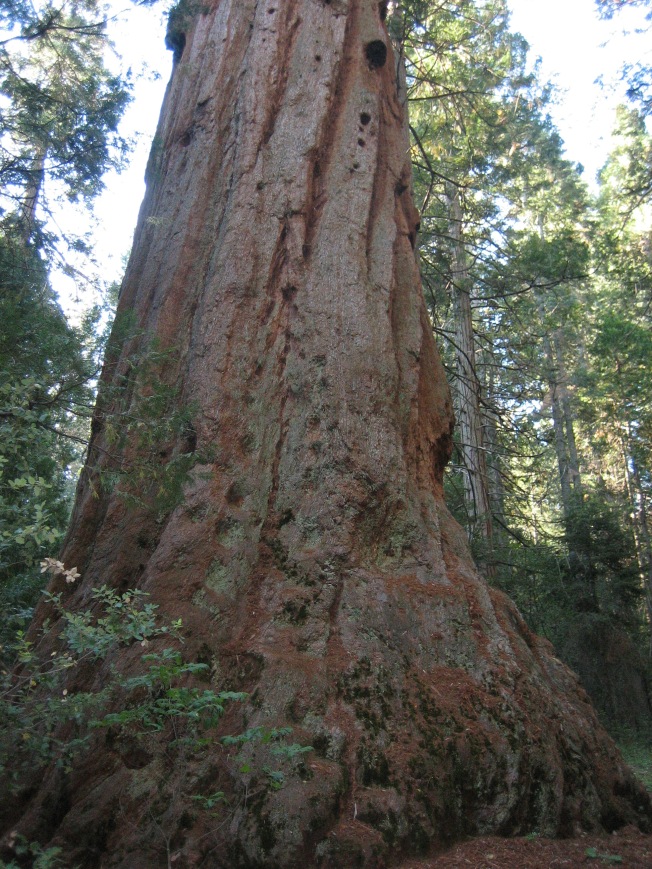
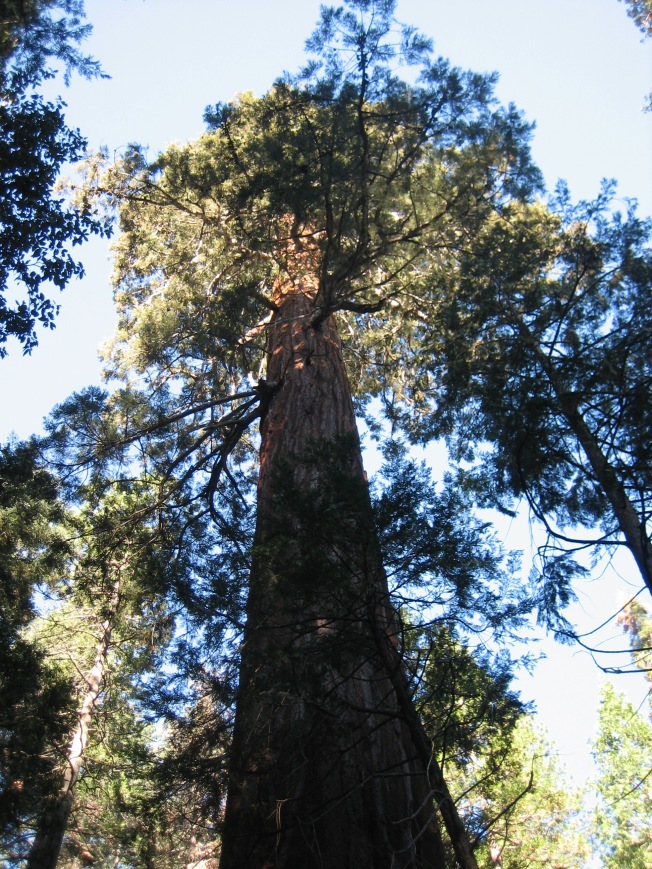
I visited the Trail of 100 Giants during the summer of 2015. It is a magical, holy place. As the name of the trail implies, the visitor sees so many massive trees. I think it is difficult to comprehend the enormous scale of the trees from a photograph. Trust me, these trees are BIG, not just tall, but wide as well, with bark that is inches thick.

IMG_3101When I walked the trail, visitors were allowed to leave the path in order to get right up next to the trees, proving ample opportunities for tree hugging. (In the Sequoia National Park, the most famous trees–the General Sherman and the Sentinel Tree, for example–are fenced off to protect their root systems from the huge number of tourists.

IMG_3094Some of the trees on the Trail of 100 Giants have hollow trunks, allowing visitors to stand or sit inside the tree. It is absolutely magical to be able to exist within such an ancient living creature. One of my favorite trees is called the Goose Pen. A person can stand entirely within that tree and look up and see the sky through an opening in the trunk.

This is the view when standing in the Goose Pen tree and looking up.

This is the view when standing in the Goose Pen tree and looking up.

Of the many places I’ve visited, the Trail of 100 Giants is one of my favorites. I highly recommend it as a destination for tree huggers and nature lovers.

I took this photo while standing in the hollow trunk of a giant sequoia. The dark frame around the edges of the photo are the walls of the trunk of the tree I was standing in.

I took this photo while standing in the hollow trunk of a giant sequoia. The dark frame around the edges of the photo are the walls of the trunk of the tree I was standing in.

IMG_3081I took all of the photos in this post.

Santa Barbara

Standard

I was feeling tired and on the verge of getting a cold the day we set out for Santa Barbara. I ended up lying in my bed napping wile Mr. Carolina drove the van. I thought the kids had a plan, an idea of where we could park so they could sleep outside. I was willing to let them handle the logistics.

I awoke to bickering, and it wasn’t just the Fighting Couple (FC) arguing. Mr. FC thought he knew where we should park. Sweet L and Mr. Carolina and Robbie didn’t like Mr. FC’s idea, but they didn’t have anything better to suggest. We could see the beach right over there, but all the street signs prohibited us from parking nearby.Park, Signs, Travel, No Parking, Transportation

Mr. Carolina got mad and said he wasn’t driving anymore. Robbie said he’d drive, but he was really bad at it, and we were soon telling him to pull over and let someone else take the wheel. Mr. FC got in the driver’s seat and headed out of town. There was more yelling, and Mr. FC relinquished the driver’s seat. Then Mr. Carolina was back at the wheel, and we were circling through the city again.

I asked about the plan, and it turned out the plan ended at get to Santa Barbara. No one had any idea of what we would do when we arrived.

California, Sea, Ocean, Pacific, Waves, Seashore, BeachSomehow, Mr. Carolina found us the perfect spot. We were on a residential street, although the residences to our left looked like mansions to me. To our right was a park. Bellow the park was a beach and the ocean. We could hear waves crashing below. Best of all, there was no sign regulating parking.

I climbed back into my bed while everyone else tumbled out of the van with their packs to sleep on the beach. Although in the light of day we saw signs declaring the illegality of beach sleeping, no on challenged the beach sleeping during the days we were there.

The next night Furthur played at the Santa Barbara Bowl. Furthur was the whole reason we were there. We didn’t have tickets, but we thought we’d just hang out in the lot. I planned to sell hemp jewelry, but that plan didn’t work out.

The official parking lot was small and the charge was $10, a ridiculously large price for a bunch of kids traveling with empty pockets. Like most of the folks arriving for the show, we found a free place to park on a nearby side street. It turned out to be a good thing we hadn’t scrounged up money for parking because the people in charge of the lot were not allowing vending.

We ended up walking back and forth on the streets between where we’d parked and the entrance to the venue. There were Deadheads everywhere, so there was something of a lot scene, but more dispersed. The Fighting Couple was hawking their hemp creations (necklaces with pouches for stones fashioned in such a way that the stone was removable and replaceable), hustling pretty hard to get money. Me? I just didn’t care much about selling hemp jewelry and quickly gave up.

As we walked through the clusters of Deadheads, Sweet L and Mr. Carolina repeatedly met people they knew, including three guys they’d lived with or near during some portion of the summer. Mr. Carolina had told me stories of these boys, called them his brothers, and that was good enough for me. Anyone Mr. Carolina trusted, I trusted too.

Mick, the eldest of the group, with dark hair and brooding dark eyes, was obviously the leader. When he spoke, everybody listened. The Viking, a young blond man with rocks wrapped in his hair and a reddish beard, was Mick’s right hand man. Karl was the quiet one, and even his birth-control glasses didn’t hide his pretty boy looks.

Some time during that afternoon I sat on the sidewalk of a side street away from the crowds and looked at shiny rocks with Sweet L and Karl and the Viking. Karl made pendants from shiny rocks and wire, and I gave him a piece of rainbow obsidian that had broken when the wind blew it off my vending table. I thought maybe he could wrap the stone in some way to hide the broken part. He was grateful for it and gave me a couple of cool shiny rocks in return.

As we sat there, I told them about my snowflake obsidian experience, and they they thanked me for sharing my story with them. I feared most people would think me a little too woo-woo if they heard that story, so I was glad the boys actually appreciated it.

Day turned to night and none of us had tickets or money to buy them. Maybe the Fighting Couple made money and bought tickets. I don’t remember. By this point in our journey, none of the rest of us wanted anything to do with them. In fact, with Sweet L’s and Mr. Carolina’s backing, I’d told them they’d have to get another ride out of Santa Barbara. In any case, the Fighting Couple (thankfully) wasn’t hanging out with me and the boys.

Mick did, however, have psychedelics, but when he shared them, none were offered to me. I thought that was a little unfriendly, but I figured since he really didn’t know me, he probably wasn’t obligated to make sure I got any.

Later, as Sweet L and I visited with other folks who weren’t going into the show, a friend of his offered us a bump of molly. I took my bit and felt exactly nothing. Later someone gave me what was supposed to be psychedelics. I imbibed that too, and over the course of the night realized it had no effect on me. Weird. I can accept that I ended up with a bunk hit, but having two different drugs from two different people in one night fail to work? No such thing had ever happened to me before.

As Sweet L and I walked through the neighborhood away from the crowds, we came across Mr. Carolina, the Viking, Karl, Robbie, and Mick standing on the sidewalk in front of one of the area’s nice houses. Mick was not having a good time.

The people the nice house belonged to joined us on the sidewalk. They were worried about Mick. They wondered if he were ok. They wondered if he needed medical attention. The wondered if he were having a bad trip. We relaxed when we realized these people knew the lingo, when we realized these people were cool. One of the boys allowed that yes, Mick seemed to be having a bad trip.

The strangers went into caretaker mode. They got cushions from their lawn furniture and placed them on the concrete in front of the house so Mick could have a comfy place to rest. Once we got Mick relaxing on the cushions, the homeowners brought us blankets. The woman brought out a jug of water and toasted English muffins smeared with peanut butter and jam. When the homeowners were ready to go to bed, they told us we could stay in their front yard as long as we wanted and even gave us a permission letter to show to any police officer who questioned us. The kindness of strangers indeed!

(Later in the night, a police cruiser did stop in front of the house. A cop got out of the car and began questioning us. Whoever was holding the permission letter showed it to him. The cop immediately backed off and drove away!)

I spent most of the night next to Mick, trying to offer him comfort. He was tired of this life, he said. He didn’t want to be here anymore. He wanted to float away and leave his body behind. I tried to keep him talking, keep him breathing, keep him with us. I was wearing a bracelet of rose quartz (the stone of unconditional love and infinite peace) on a stretchy cord. I slipped it off my wrist and onto his.

All the time, we could hear Furthur playing in the Bowl. The music was distant and a little distorted, but we could hear it, and it was ours.

We sat in front of that house for hours. I don’t know what the others were talking about while I tried to convince Mick to stay, but they were always nearby. Sometimes they’d come over and talk to Mick and me, but mostly they were doing their own thing.

At some point, Mick was mostly back to himself, and Mr. Carolina, Robbie, Sweet L and I went one way, and the other boys went another. I drove the van back to the spot we’d found the night before and settled in. We stayed there the next day and one more night before Mr. Carolina, Sweet L, Robbie, and I headed to Los Angeles.


Images courtesy of https://pixabay.com/en/park-signs-travel-no-parking-39412/ and https://pixabay.com/en/california-sea-ocean-pacific-waves-2666059/.

Electricity, Restrooms, & WiFi, Oh My! (Part 2)

Standard

If you read the first part of Electricity, Restrooms, & WiFi, Oh My! you know I am writing in response to a post on vaninspirations by Liselle. When Liselle first started living in her van full time, she wondered how she could charge her phone and use the restroom each night before bed without spending a lot of money. I suggested she spend her evenings at public libraries, then started thinking of all the other places folks could hang out, access the internet, charge electronics, and/or use the restroom while spending little or no money.

Part 1 of Electricity, Restrooms, & WiFi, Oh My! covered public and university libraries, as well as corporate coffee shops and restaurants. Now on with Part 2!

View of Books in ShelfChain bookstores often allow or even encourage people to hang out without requiring a purchase. There’s sure to be a restroom on the premises, and there’s typically free WiFi available. Try to find a comfy chair near an electrical outlet for charging, or if there’s a coffee shop area, look for outlets there.
I’ve noticed that in some big cities, larger grocery stores sometimes have a snack bar type area, ostensibly so people can eat the deli food or pre-made sandwiches they’ve just bought. If there are electrical outlets in such a seating/eating area, it might be a good place to hang out after grocery shopping to charge electronics. Grocery stores almost always have restrooms, and these days some of them even have free WiFi.

Here’s the deal. Stores want to make it easy for people to spend money. If a potential customer has to leave the store to attend to a bodily function, that customer might not return to make a purchase. So if you’re in a place where items are for sale, there’s bound to be a restroom.

Last summer, I frequented a Target store offering free WiFi. (That was in California, but maybe it’s a national trend.) The store also had public restrooms and an in-store Starbucks with seating. One evening I went into the seating area to look at photos I’d just purchased and found people hanging out, playing one of those card games like Magic without even a cup from a purchased beverage on their table. I didn’t look for electrical outlets, but if there was at least one there, it would be a great spot for accessing the internet and charging up with no out of pocket expense.

Shopping malls might work for passing time with access to restrooms. Food courts in malls are usually so big that no one would notice how long someone has been sitting at table. It’s been a while since I’ve been in a mall, but they may routinely offer WiFi and electrical outlets. Lots of people do the mall walking thing, so one could probably get in some exercise while waiting for that last visit to the restroom before bed.

Another place I don’t have much experience with but might work is a hospital. Or course, there are public restrooms in hospitals. There are likely to be people passing time in cafeterias and waiting rooms, and it would seem logical to offer electrical outlets to the people there. In my experience (in towns of 8,000 to 85,000 people), I’ve never seen a security guard challenging anyone in a hospital, but I’ve heard lots of intense activity happens in inner-city hospitals. Again, experiences differ depending on the community. If I were looking for places to spend my evenings, I might scope out a hospital to find public access restrooms, electrical outlets, etc., but I would not try to use hospital facilities too often. While no one may think twice about seeing the same person repeatedly in a library, mall, or on a university campus, the person repeatedly in a hospital waiting room might attract attention.

A Greyhound bus station might work occasionally too. Friends and I once slept for a few hours on the floor of a Greyhound station when we had no tickets, no money, and no plan. There are usually people hanging out there, even when there’s not a crowd waiting for the very next bus. (People hanging out could have been dropped off early or could be waiting to receive money through Western Union.) Five years ago when I was riding the ‘Hound regularly, I saw that bus stations had begun to provide “charging stations” (rows of electrical outlets, usually above a counter) so people in the waiting area could charge their phones. Greyhound stations definitely have restrooms, and I guarantee no one will think it strange to see you brushing your teeth in there.

Hotels can usually work for a restroom break,  For best results, pick a hotel that’s part of a chain and has a lobby. Nearly every hotel lobby has restrooms. Stroll in casually and confidently and find the restroom. If you’re feeling bold, find an electrical outlet near a comfy chair in the lobby or in the business center. If questioned, you can say you’re supposed to meet your mom there. (You might not look like you belong in the lobby of a La Quinta Inn, but your mom probably does. On the other hand, no matter what you look like, savvy hotel workers know you might have money in your pocket to rent a room or drink in the hotel bar.)

If you just need to use the restroom and pass some time, parks can be a good bet. They usually have restrooms (cleanliness may vary) and tend to be open fairly late. If you are a van dweller/rubber tramp, parks are a good place to cook and eat dinner, and you’ll probably blend in with the other people hanging out there. I’ve also encountered parks with WiFi access.

If you’re in a town where a friend lives, arrange to spend the evening with that person. Your friend will probably allow you to charge your electronics and may even invite you to stay for dinner. You’ll have restroom access before you drive off to park for the night, and your friend may offer you a shower. In addition, you’ll get to spend time with someone you like.

Recently, I learned about Catholic Worker hospitality houses from friends who do volunteer work with a Catholic Worker group in Las Vegas.

Each Catholic worker community is different as far as what sort of services it provides. The Catholic Worker Movement website states,

Catholic Workers live a simple lifestyle in community, serve the poor, and resist war and social injustice. Most are grounded in the Gospel, prayer, and the Catholic faith, although some houses on this list state that they are interfaith. Each Catholic Worker house is independent and there is no “Catholic Worker headquarters”.

Some Catholic Worker communities publish newspapers and some provide services for homeless and poor folks. Go to http://www.catholicworker.org/communities/directory.html to find…”a list of all the Catholic Worker communities that we know about, indexed by state or country.” Some hospitality houses let folks do laundry and/or take showers and just hang out.

I hope these ideas help van dweller/rubber tramps/traveling folks find places to meet needs that can’t be met in their vans. If readers have other suggestions, please leave a comment with your ideas.

Image courtesy of https://www.pexels.com/photo/view-of-books-in-shelf-256421/.

Deer Creek Grove

Standard

Deer Creek Grove is the southernmost grove of giant sequoias, “about 250 air miles south of northernmost Placer County Grove,” according to Dwight Willard’s excellent book A Guide to the Sequoia Groves of California. Willard goes on to say that the grove “…has about 35 mature sequoias strung along the creek, plus many younger trees. None are exceptionally large.”

Willard also explains that the grove was never logged for sequoias. “The grove was selectively logged for pine and fir only between 1914 and 1920, but has been preserved from cutting since then.”

The grove is in the Sequoia National Forest, near the small community of Pine Flat. It is a couple of miles from the California Hot Springs community.

I visited Deer Creek Grove early one morning when I was in the area in the summer of 2015.

IMG_3372

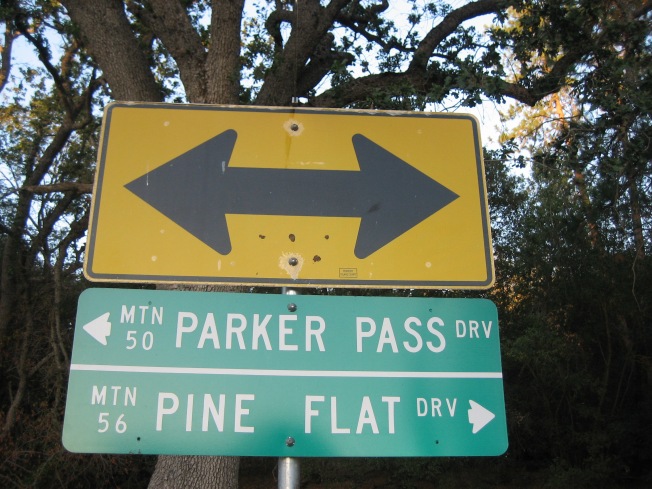
To get to the grove from Mountain Road 50, go straight (onto Mountain Road 56 toward Pine Flat) when Mountain Road 50 ends at Mountain Road 56. From Mountain Road 56, turn right when the road dead ends at Mountain Road 50. A sign labeled “Deer Creek Grove” will point you to a left turn onto forest road 23S04. Follow that winding gravel and dirt road for several miles, through ranch land, then forest. The road ends in a gravel parking area at the lower edge of the grove. When I visited, there was no sign, nothing other than the parking area and a dilapidated picnic table in a clearing to indicate that I had arrived.


Unlike other trails through (the admittedly few) sequoia groves I’ve visited, the trail through Deer Creek Grove is a real hike.

IMG_3197.JPG

The path is barely visible, marked only by other feet that traveled on it in the past. Some parts of the trail are on a somewhat steep incline. I thought I was in decent physical condition when I tried to hike through this grove, but I was soon huffing and puffing and panting as I ascended.

I wasn’t prepared for a real hike when I visited Deer Creek Grove. I was wearing a skirt when I really needed long pants to adequately protect my legs. I also really needed my walking stick to help me up the steep parts of the trail, but I’d left it in the van. I should have used a backpack to carry water instead of holding my bottle in my hands. I hadn’t been planning on mosquitoes either, but they were out in force, biting the hell out of me. The only bug repellent I had was some hippy dippy oily Tom’s of Maine stuff which made my skin greasy, but did absolutely zero to deter the mosquitoes.

IMG_3185

I didn’t stay in the grove very long. I didn’t hike the entire trail (which Willard says “…passes by all the grove’s good-sized trees”). I just wasn’t having much fun, so I decided to backtrack and leave. I did get a few nice photos before I left.

IMG_3189


IMG_3188

IMG_3191.JPG

IMG_3192

I took all photos in this post.


Kern Valley Museum

Standard

IMG_2833

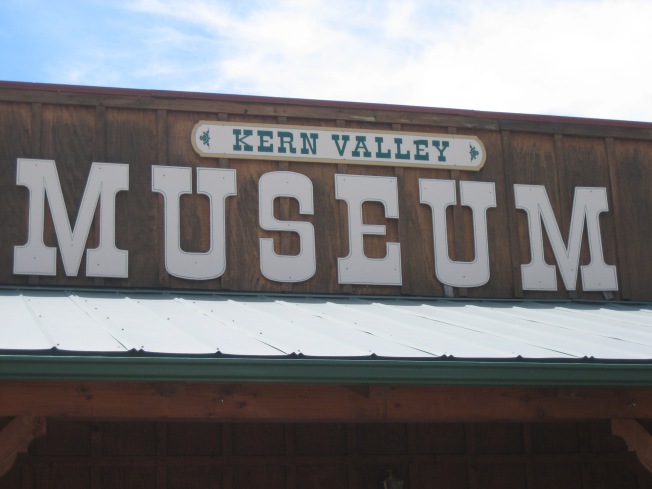
I visited the Kern Valley Museum in Kernville, CA in the late spring of 2015. I was impressed!

Other small town history museums I’ve visited (I’m looking at you, Truth or Consequences, NM and Quartzsite, AZ) have been jumbled, hodge- podge messes, filled with any (literally) old thing with little-to-no explanation of historical context. The museum in T or C is huge and rambling, with so much (too much) to see and difficult (both physically and mentally) to read explanation cards. Quartzsite’s museum is smaller and more cluttered with even less explanation of why objects are on display.

The Kern Valley Museum has none of those problems. Housed in a former doctor’s office, the museum staff has arranged similar items in displays in the former exam rooms. Visitors can spend time in one room with photos and artifacts from the various movies filmed in the region, while in other areas folks can learn about local money-making endeavors such as mining and ranching. The museum is very clean, and exhibits are well-lit, with brief and easy to read explanatory notes.

In the museum’s backyard, larger items are on display.

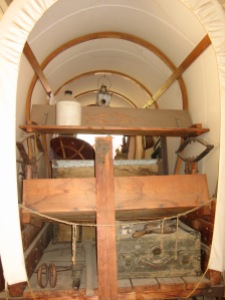
One cool item in the back area is a reconstructed covered wagon originally from pioneer days. It was brought from Missouri, over the Oregon Trail, in 1850. Between 1998 and 2000, it was restored from a pile of lumber, a box of hardware, and some wheel hubs.

IMG_2816

This is the covered wagon at the Kern Valley Museum


IMG_2817

IMG_2823

This is the front view of the covered wagon at the Kern Valley Museum. I love the suitcase on the lower right.

IMG_2815

This is the rear view of the covered wagon at the Kern Valley Museum. It makes my van look so comfy and spacious. Can you imagine riding in such a wagon from Missouri to the West Coast?


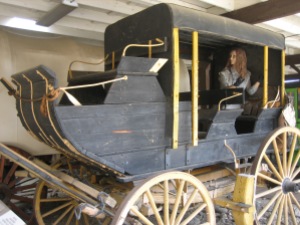
A horse-drawn carriage is also on display.

IMG_2818


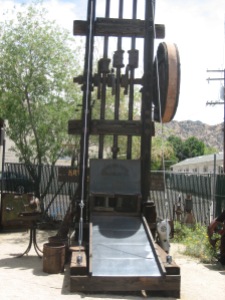
There is gold mining equipment in the back area as well.

IMG_2819

IMG_2820

IMG_2821

A small room is set up to look like a blacksmith’s shop. Since my great-grandfather was a blacksmith, I was interested in the equipment on display.

IMG_2822

There’s a small cabin behind the museum too. If I remember correctly, the cabin was moved from its original location to the museum in Kernville. I don’t recall if the furnishing were pieces originally from the cabin or historically accurate items that came from elsewhere. The museum’s website calls it “a restored and furnished 110 year old cabin…”


Self-portrait in cabin's mirror.

Self-portrait in cabin’s mirror.

IMG_2831

Cabin’s kitchen area.

IMG_2832

Cabin’s sleeping area. I love the quilt.


I enjoyed exploring the Kern Valley Museum and recommend it as an educational stopping point for any visitors to Kernville.

If you enjoyed this post, you might like to read about my visit to the nearby Old Kernville Cemetery.

All photos in this post were taken by me.

Success Dam & Lake

Standard
IMG_2939

This is the information sign at the Success Dam and Lake scenic lookout. I guess I managed to get my shadow in the photo.

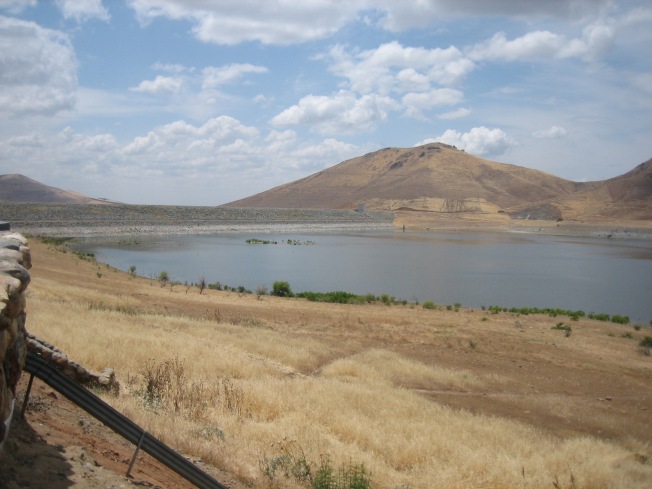
On Highway 190 between the California towns of Springville and Porterville is the Success Dam and Lake scenic lookout. I stopped to visit once, but there wasn’t much to see. In the pretty big parking area were a couple of overflowing trash cans and port-a-potty I was not brave enough to visit. There’s a low stone wall separating the parking lot from the lake (which I suspect was much lower than usual, due to the California drought), and an information sign on the wall.

IMG_2943

On the left of the photo, you can just see the low stone wall separating the parking lot from the lake. The dam is shown at the back edge of the lake.

The day was hot and windy, and if the water in the lake helped cool the air, I didn’t notice. I only stayed long enough to take some photos of the lake and what I think were datura flowers growing on the land between the parking lot and the water.

IMG_2951

I think this is a datura flower.

According to https://en.wikipedia.org/wiki/Datura, Datura is a genus of nine species of poisonous vespertine flowering plants belonging to the family Solanaceae. They are known as angel's trumpets, sometimes sharing that name with the closely related genus Brugmansia, and commonly known as daturas. They are also sometimes called moonflowers..

According to https://en.wikipedia.org/wiki/Datura, Datura is a genus of nine species of poisonous vespertine flowering plants belonging to the family Solanaceae. They are known as angel’s trumpets, sometimes sharing that name with the closely related genus Brugmansia, and commonly known as daturas. They are also sometimes called moonflowers…


IMG_2946

(I took all of the photos in this post.)