Category Archives: Art

Collage Book

Standard

My latest collage project was decorating a book for a friend. I found a small notebook with hard covers for a good price at a thrift store. The images on the covers were ugly, so I decided to collage and decoupage.

This is the front of the collaged book.

This is the front of the collaged book. The mirror, key, peace sign, and coin are actual objects, so this is a mixed media piece.

This is the back cover of the collaged book.

This is the back cover of the collaged book.

This is what the front and back covers look like side by side.

This is what the front and back covers look like side by side.

My friend is going to use this book to log her travels in her Dolphin motor home.

Working Man Statue

Standard

When I passed through Mesa, Arizona, I saw a statue that is obviously the fellow worker of the Toilet Paper Hero of Hoover Dam.

IMG_4348

IMG_4349According to the Waymarking website, this man is John W. “Pete” Peters. The statue was sculpted by Russell W. Bowers and stands on Main Street, near Morris Street. The statue was donated to Mesa’s permanent sculpture collection by Western Block Company, a company Pete owned. It was dedicated in January 2003.

IMG_4347

IMG_4350 I like the way this statue seems dynamic, as if Pete is about to actually lay down that cinder block and spread mortar on it. Most statues seem static, so this one really stood out for me.

I took all of the photos in this post.

Old White People Crossing

Standard

It was a slow weekday at the Bridge. More accurately, it was another slow weekday at the Bridge. The few tourists milling around were not buying, and all of the vendors were bored.

Gregorio was wandering around, talking to vendors, generally just passing the time. He strolled not very far out onto the Bridge and came back chuckling.

This is what he’d seen:

IMG_3709

No one I know has any idea who made the stencil (as it should be with street art), but I think the artist(s) did a great job. I love the details of the people’s hats and their stooped posture. The cane is a nice touch too. I think as a whole, the piece is hilarious.

Toilet Paper Hero of Hoover Dam

Standard

IMG_3567I first learned  of the Toilet Paper Hero of Hoover Damn while reading a back issue of Sunset magazine.

I was delighted to learn the statue won the Reader’s Choice Award for the West’s Most Outrageous Roadside Attraction, beating out The Mystery Spot in Santa Cruz, CA; the 22 foot-in-diameter donut atop the Randy’s Donuts building in Inglewood, CA; Spuds Drive-In Theater (complete with a “two-ton tater sitting in the bed of a candy-apple 1946 Chevy truck”) in Driggs, ID; the International UFO Museum in Roswell, NM; and the Hole n’ the Rock in Moab, UT.

At the time I read the the short blurb about the Toilet Paper Hero, I had toilet paper on my mind.

I was a camp host in a National Forest, and one of my duties was the upkeep of restrooms.

If, when you think of restrooms, your brain conjures images of flush toilets and sinks with running water and soap and paper towels nearby, you are not thinking of my campground restroom experience. The campground I was hosting had pit (also called “vault”) toilets. Nowhere in my campground nor in any other public campground on the mountain was there running water. The toilets I maintained didn’t flush, and there were no sinks, no soap, no paper towels.

In my five months as a camp host, I cleaned human feces off restroom floors and walls, chased a family of mice from a restroom, and dealt with a lot of toilet paper. I immediately knew that the Toilet Paper Hero was my kind of working class champion.

I was excited to see the Toilet Paper Hero was associated with the Hoover Dam. I’d been to the Hoover Dam, and I knew it was close to Las Vegas, NV. Since I was planning to visit friends in Vegas when I left California, I decided I’d make a pilgrimage to the home of the Toilet Paper Hero in Boulder City, NV.

I left Vegas by 7am on Saturday morning. I’d planned my route in advance, but had not been able to find an exact street address for the statue, nothing that was easily plugged into Google Maps. All I knew was that I had to take US 93, then turn onto Nevada Way and drive into downtown, looking for the corner of Nevada Way and Ash/Wyoming Streets. (Directions courtesy of http://www.roadsideamerica.com/story/23150.)

I almost chickened out. I came to a fork in the road where I had to decide if I was going to go into the unknown (AKA downtown Boulder City) or just bypass the town and head toward the Hoover Dam and onward to Arizona. Since I wasn’t 100% sure of my directions, I was a little nervous. What if I got lost? What if I made a fool of myself?

Oh, come on! I chastised myself. You can do this! It’s the Toilet Paper Hero, for goodness sake. You’ve been looking forward to this for months.

So I did it. I found the Hero and made his acquaintance and took some photos.

IMG_3551

This is the informational plaque which stands next to the Hero.

The statue was created by artist Steven Liguori. According to http://www.roadsideamerica.com/story/23150,

In 2007, Boulder City commissioned local artist Steven Liguori to immortalize “Alabam,” one of the unsung workers who helped to build nearby Hoover Dam.

Steven had earlier sculpted a heroic-size statue of a high scaler, one of the Dam’s most glamorous and exciting workers. But he felt that the unseen people of Hoover Dam deserved to be honored, too. When Boulder City launched a project for public art, Steven submitted his proposal for a statue of Alabam. The city, to its credit, accepted it.

Steven sculpted Alabam as he looked in old photos from the 1930s. The eight-foot-tall bronze statue — mixed with copper salvaged from the Dam’s electrical grid — shows Alabam wearing a fedora, overalls, and thick gloves, with a broom slung over his shoulder like a combat rifle, and a large bandolier of toilet paper rolls strapped across his chest. The man definitely had a sense of style.

IMG_3554Alabam was unveiled on a Boulder City street corner on June 29, 2007.

The same website says,

Alabam was a specialist. His job was to clean the outhouses of the vast construction site: sweeping refuse, tossing lime into holes, and restocking the always-diminishing supply of toilet paper.

Not much is known about Alabam. He was among the older workers. “Maybe his name was John or Bill, but there were lots of Johns and Bills at the Dam,” said Steven. “He was probably from Alabama, so they called him ‘Alabam’.”

IMG_3553In a job site filled with draftsmen and construction designers, Alabam referred to himself as “the sanitary engineer.”

“Alabam’s role might not seem important, but it was,” said Steven. Workers would start the day with a big breakfast at the mess hall, then pack a big lunch to take to the construction site. “But once you got to the Dam, you were stuck there all day.” The outhouses got used — a lot.

“Can you imagine cleaning latrines for 7,000 men in 120 degree heat?” Steven asked. “Can you imagine the smell? Oh my god!”

I really love that this statue is a based on a real person with a real personality, a man who had the sense of humor and the sense of his own worth to call himself “the sanitary engineer.” It would be a cool piece of art if it were a fictional representation of all the men who cleaned outhouses at the building site of the Hoover Dam. However I like it so much more knowing it is based on an individual, a real person who, like me and my co-workers, lived and breathed and sweated and was dirty at the end of the work day.

IMG_3557

I’m glad I overcame my silly little fear of the unknown and stopped by to visit with Alabam.

IMG_3572All photos in this post were taken by me.

Little-Known Painting by Ted DeGrazia

Standard

IMG_2333

I took this photo of a little-known painting by Ted DeGrazia in a building in Phoenix that was soon to be demolished.

Don’t know who Ted DeGrazia is? I didn’t either until Nolagirl took me to the building (which was open to the public for the weekend) to see this work and another long piece that covered an entire side wall. (I didn’t think I could get a good shot of that piece, so I didn’t even try. I couldn’t get the entirety of the piece in one shot, and the lighting was poor.)

According to http://en.wikipedia.org/wiki/Ettore_DeGrazia,

Ettore “Ted” DeGrazia (June 14, 1909 – September 17, 1982) was an American impressionist, painter, sculptor, composer, actor, director, designer, architect, jeweler, and lithographer. Described as “the world’s most reproduced artist”, DeGrazia is known for his colorful images of Native American children of the American Southwest and other Western scenes. DeGrazia also painted several series of exhibitions like the Papago Legends, Padre Kino, Cabeza de Vaca.

According to http://degrazia.org/about-degrazia/bio/,

The son of Italian immigrants, Ettore DeGrazia was born June 14, 1909, in the Morenci mining camp of Territorial Arizona. His early childhood experiences in the ethnically diverse community evolved into a lifelong appreciation of native cultures in the Sonoran Desert and a passion to create art depicting their lives and lore.

DeGrazia’s paintings, ceramics and other artwork steadily attracted media attention including the NBC newsreel “Watch the World” and a profile in the 1953 National Geographic article “From Tucson to Tombstone.”

From 1960 to the mid-1970s DeGrazia became wildly successful and the gallery flourished with hundreds of thousands of yearly visitors. To protest inheritance taxes on works of art, DeGrazia hauled about 100 of his paintings on horseback into the Superstition Mountains near Phoenix and set them ablaze in 1976. This infamous event was reported in such publications as The Wall Street Journal and People magazine, becoming part of DeGrazia’s legend before his death in 1982. By this time, the artist had established the DeGrazia Foundation to ensure the permanent preservation of his art and architecture for future generations.

As for the murals in the now demolished building?

According to http://www.phoenixnewtimes.com/arts/say-goodbye-to-ted-degrazia-and-lauren-lees-roosevelt-row-murals-6573461,

Despite public outcry, including a protest and an online petition, only the smaller of two Ted DeGrazia murals, the one portraying a dancer[photo above], inside the 222 building will be salvaged.

DeGrazia painted the murals, the larger of which depicts the history of alcohol, more than a half-century ago.

According to http://www.azcentral.com/story/entertainment/arts/2015/03/05/degrazia-murals-open-to-public-at-green-haus-in-phoenix-during-art-detour/24402531/,

DeGrazia painted the 47-foot mural of cancan girls, alcohol distillation and flying women with chalices 65 years ago to pay off — legend has it — a bar tab at a Phoenix lounge. Experts estimated it would cost at least $250,000 to save. Although there was a public outcry, no one stepped forward with funding or a concrete plan to preserve and re-install the mural elsewhere.

The Observer reported in January 2015,

The larger mural has been protected by a wall since the building became a working studio. The smaller one is painted on drywall that apparently could be moved to a new location, but the big mural is drywall-on-brick and probably can’t be moved. (http://www.observerweekly.com/content/historic-phoenix-bar%E2%80%99s-ted-degrazia-murals-facing-bulldozer)

DEGRAZIA

This photo by Catherine Slye shows part of DeGrazia’s larger mural that was demolished along with the building.

DEGRAZIA

Another photo by Catherine Slye shows a different section of DeGrazia’s larger mural.

I was glad to have the opportunity to see these murals before they were demolished along with the building to make room for more housing for rich people in Phoenix. I guess that’s progress.

The Walls of Phoenix

Standard

I was going to sell jewelry and shiny rocks in a parking lot craft market near Roosevelt Row during First Friday. I arrived early, so I walked around a bit and took some photos of the murals painted in the area.

IMG_2310

This mural is on the wall of a very small parking area. If a car had been parked in this spot, I’d have never seen this mural, much less gotten a photo of it.

The paintings in the next several photos are on a building on 4th Street, almost on the corner of Roosevelt. The actual corner of 4th Street and Roosevelt is a vacant lot, so this mural is visible from Roosevelt Street.

IMG_2303

This is about one-third of the full mural.


This is a detail of the detail.

This is a detail of the detail. I really like the Day of the Dead-meets-flapper look, although I’m not sure how a skull could possibly have lips and eyelashes.


IMG_2301

And how could a skull have eyeballs? I do like this dapper skull guy.

The other two thirds of the mural has a different vibe, more ethereal and dreamy.

IMG_2304        IMG_2305

IMG_2307

I found out online that this portion of the mural was painted by Tato Caraveo. http://www.thelostleaf.org/Murals.aspx


IMG_2306

This portion of the mural is also by Tato Caraveo. To see him working on it, go to http://www.thelostleaf.org/Murals.aspx and scroll down.


IMG_2308

I especially like this cat and its shadow.

The next piece has more of a graffiti vibe to it. It was painted just under the rafters of what seems to be an abandoned house.

I believe I took this photo between 4th and 5th streets on Garfield, but maybe it was between 5th and 6th Streets.

I believe I took this photo of cow graffiti between 4th and 5th Streets on Garfield, but maybe it was between 5th and 6th Streets…definitely on Garfield though.

The last piece is at 3rd Street and Roosevelt, and I took the photo the next afternoon when I was out and about with Nolagirl.

IMG_2330

This mural was painted by Lauren Lee, and it’s called Three Birds.

The building this mural is on is scheduled for demolition. By the time you read this post, this mural will probably be forever gone.

(I took all the photos in this post.)

Humpty Dumpty

Standard
Humpty Dumpty sat on a wall,
Humpty Dumpty had a great fall.
All the king’s horses and all the king’s men
Couldn’t put Humpty together again

IMG_2444

Mesa, Arizona has an outdoor permanent sculpture collection. Humpty Dumpty is one of my favorite pieces in that collection, and I took this photo of him in March 2015. I love his yellow bowtie that matches his socks! I love his metalic shirt and the color scheme of his striped bodysuit. Most of all, I like the big, big smile on his big, big face!

The artist who created Humpty is Kimber Fiebiger. According to the artist’s webpage,
Kimber Fiebiger creates bronze sculptures that range from fun and whimsical, to classical and contemporary. She lives in Minneapolis yet her sculptures have been sold all over the country where she has won numerous awards.
Kimber Fiebiger has crated a LOT of sculptures of Humpty Dumpty. See more here: http://artbykimber.com/humpty-dumpties/jumbo/, here: http://artbykimber.com/humpty-dumpties/small/, and here: http://artbykimber.com/humpty-dumpties/large/.

Eliphante Part 2

Standard

IMG_2544

The artist Michael Kahn spent 30 years of his life creating, while painting and residing at, the three acres known as Eliphante. The buildings and structures at Eliphante, while expressions of creativity and artistry, were also Michael’s solutions to the practical needs for work space, studio’s [sic], shelter and housing for himself and his wife Leda. Michael lived there until his death in 2007. Leda remained there until 2009, and now lives in Cottonwood AZ. (from http://www.eliphante.org/)

This post is Part 2 of the story of the afternoon I spent at Eliphante.

As I walked the grounds of Eliphante, an old delivery truck that had been turned into a storage shed caught my attention.

IMG_2500

Old delivery truck turned into a storage shed. Notice the signature Michael Kahn bright color paint job on the truck’s side and hood.

IMG_2501

I like the way it looks as if the truck may be turning to stone…or maybe the stones are turning into a truck.

One can walk out of the driver’s side of the truck and enter another storage area with a roof over it.

IMG_2505      IMG_2507

At Eliphante, even the containers holding fasteners looked like art to me.

As I was taking photos in this storage area, I ran into the other guy I’d met at NeoTribal The Gathering. He looked to me like a young Timothy Olyphant (http://www.imdb.com/name/nm0648249/) and made my heart beat faster. Although he seemed glad to see me, we only spoke briefly before he drifted off to do other things. Ah well, he was too young for me anyway.

In many buildings on the grounds, bits of colored glass and whole glass bottles were used to allow light into rooms, but still afford privacy. Here are some examples of such use of glass:

IMG_2510

As sunlight shines through the glass, colors play upon the opposite wall.

IMG_2509     IMG_2512

The above photos show an inside and outside view of colored glass and bottles used as tiny windows that allow light into the room. I think the wall is made of cob or some other type of dried mud and straw construction material.

IMG_2513

Corner wall made from cob (or similar building material) and glass bottles.

IMG_2516

Unfortunately, the solar bath house was not open for bathing.

Pipedreams, “the labyrinthine art gallery” ( http://www.nytimes.com/2008/01/31/garden/31elephante.html?pagewanted=all&_r=0) was amazing. It is composed of several rooms leading into another, each room filled with color and art.

Mosaics of glass, tile, stone, and mirrors covered some of the interior walls of Pipedreams .

IMG_2520

IMG_2528     IMG_2534

IMG_2535     IMG_2523

In some places light passed through colored glass set in the ceiling or walls, adding moving bits of color to the floor or opposite walls.

IMG_2522     IMG_2521

I sat on the floor a long time and watched the infinitesimal changes in the patterns of colored light. The light shimmered and moved, and the entire vibe was incredibly psychedelic. As I moved through the space, I wondered how much LSD (or other hallucinogens) Michael Kahn had taken in his lifetime, or if he were just one of those people who naturally experiences life as one continual psychedelic trip.

IMG_2532

This keyboard was tucked in an alcove in Pipedreams. Notice the Michael Kahn signature cacophony of colors on the wall all around it. (How could anyone NOT notice those colors?)

The main room of Pipedreams reminded me of a chapel somehow. It was filled with wood (driftwood? branches?) that curved and flowed. I imagined ceremonies being held here.

IMG_2531

The main room in what felt like the center of Pipedreams. The other rooms flowed in and out of this one.

IMG_2538

This photo shows an alcove in Pipedreams which houses a large piece of art. Notice the vaginal qualities of the portal.

There were art installations in many places on the grounds of Eliphante. Some were functional (like the glass bottles imbedded in walls and the very buildings themselves), but many pieces were art for art’s sake. One of my favorites was this assemblage of wood, stones, and mirrors.

IMG_2541

I particularly like the shape of this creation and the juxtaposition of the natural and human-made elements.

The last major building on the property was the one that gave the whole place its name. According to http://www.nytimes.com/2008/01/31/garden/31elephante.html?pagewanted=all&_r=0, this building is called Eliphante because of its “long, trunklike entrance made of rock and an irregularly mounded roof. ‘Aaah, Ella-fahn-tay,’ a friend joked soon after it was built, giving it a playful faux-French pronunciation.”

Unfortunately, Eliphante was closed for restoration during my visit, and I couldn’t venture inside.

IMG_2543

Well, yes, I can see how this building could look like an elephant (especially if viewed through a psychedelic lens).

I was able to take some photos of the exterior of Eliphante.

IMG_2545     IMG_2546

The two photos above are views of some of Eliphante’s “stained glass.”

IMG_2548

Another view of the Eliphante trunk.

IMG_2565

This is probably my favorite installation at Eliphante. I like that it’s functional and can actually help a person get where she wants to go. I also like that it’s making use of old, rusted saws that look cool but aren’t being used for their original purpose. I’m impressed by the person who looked at a bunch of rusty saws and had the idea to turn them into signs.

IMG_2568

Hmmmm….Someone saw a rock on the trail and decided to paint it to look like an Amanita muscaria mushroom…

I exited Eliphante through this passageway to the trail to the parking area.

IMG_2553

IMG_2555     IMG_2563

Eliphante is my kind of place. I really dig so many of the aspects that make it magical: bright colors, collages and mosaics, assemblages, functional art, art not just as a lifestyle but as a way of life. I love the way art is integrated in nearly every aspect of life at Eliphante. I feel really blessed to have found this place (and the kind people who care for and maintain it) and to have been able to spend an afternoon exploring it. Of course, I am now a life member of the Eliphante community, and I plan to visit again.

I took all the photos included in this post.

Eliphante Part 1

Standard
IMG_2580

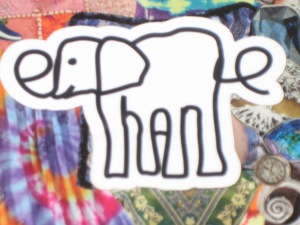
I took this photo of the Eliphante logo on top of one of my collages. Can you see the word “eliphante”?

As I was getting my tent up at NeoTribal The Gathering, folks started setting up on my left. They left a nice big space between my tent and theirs, and the space stayed empty most of the day. Late in the afternoon, it seemed as if people were hanging out between my tent and the next one, maybe doing something interesting, so I popped out to see what was going on.

I met three people who were spreading the word about a place Eliphante. I had never heard of Eliphante, or Cornville, Arizona, where it is located. (Cornville is reached via Interstate 17. It is about 97 miles north of Phoenix and about 20 miles south of Sedona.)

The folks had a book called Home Work: Handbuilt Shelter by Lloyd Kahn. (Find out more about Home Work here http://www.shelterpub.com/_home_work/HW-book.html and here https://www.goodreads.com/book/show/381862.Home_Work?from_search=true.) In Home Work, there were multiple pages dedicated to Eliphante. I looked at the pages and became entranced. I could tell immediately from the photos I saw that Eliphante is a magical place.

(You can go here http://www.shelterpub.com/_home_work/_kahn/_122-123/kahn_122-123.html to see images of and text about Eliphante as they appear in Home Work.)

It turns out that the three people lounging next to me are caretakers at Eliphante. They are artists who live in the  “kaleidoscopic, hand-built, sculptural village” to help maintain and restore what was built there by “the artist Michael Kahn and his wife Leda Livant over a 28 year period beginning in 1979.” (Thanks to http://en.wikipedia.org/wiki/Eliphante for basic information.) The folks were at the festival to spread the word about Eliphante and to invite people to the series of events happening there in a couple of weeks. I immediately wanted to go and see the place for myself.

(You can also learn more about Eliphante, see more wonderful photos of the place, and watch a trailer for a documentary called Eliphante: Where Life is Art and Art is Life at http://www.theshelterblog.com/eliphante-michael-kahns-sculptural-village-arizona-desert/. Watch for the goat in the trailer.)

I talked for quiet a while to the two guys who were representing Eliphante. They told me the county won’t give the place a permit to host events there (because of the zoning, I think), so all events are open to members only. Memberships are for a lifetime, and folks get membership cards. (One of the guys whipped out his membership card to show me.) I knew I wanted to be a member even before I visited.

Here’s what the Eliphante website (http://www.eliphante.org/) has to say:

Eliphante is a private residence looked after and cared for by the 501(c)(3) non-profit Eliphante, Ltd. We are volunteer run and member supported, on an invitational basis to organizational members. Together, we are working to preserve and restore the work of the late artist Michael Kahn and his wife Leda Livant.

After the festival, I looked at my schedule of dental and van repair appointments and decided I could make the trip to Eliphante on the Saturday before I started my temp job. I went to the Eliphante website to find out contact info, then sent an email explaining who I was, how I’d heard of the place, and saying when I wanted to visit. Within a couple of days, I got a message from one of the guys I’d met. The message said, “So glad to hear from you. You were a great neighbor at the gathering. You are on the list for Saturday…”

On the day I visited, there was an accident on I -17 that brought traffic to a complete standstill. (I was listening to the Grateful Dead, so I just danced in my seat and didn’t let myself be bothered by the delay.) I got to Eliphante later than I had planned, but still with plenty of time to look around during the period when they were receiving guests members.

The directions I’d been sent were very good, and I only had to stop to consult the map once, when I thought I’d missed a turn. Actually, I hadn’t gone far enough to get to that turn. Once back on track, I found the place easily, although no one in a vehicle could stumble upon the place. There are no signs directing drivers to the property.

Upon arrival, I found the creek still flowing. I didn’t realize there were rocks arranged above the level of the water on which I could have walked across, so I just lifted my skirt and waded through. ( I was glad I was wearing my sturdy, all-terrain Keen sandals).
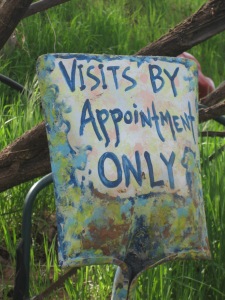
I can't imagine anyone stumbling upon Eliphante, this photo shows the clever signs reminding members that visits are by appointment only.

I can’t imagine anyone stumbling upon Eliphante, so the clever sign in this photo I took must be a reminder to members.

As soon as I walked up to the outdoor kitchen, a little kid (probably about four years old) introduced himself and his brother. Then I saw one of the fellows I’d met at NeoTribal. We were happy to see each other, and he took me to sign the disclaimer that said I wouldn’t hold Eliphante liable if I got hurt or died while I was there. I like the way they got it right out there that anything could happen, and I was responsible for my own damn self.
IMG_2498

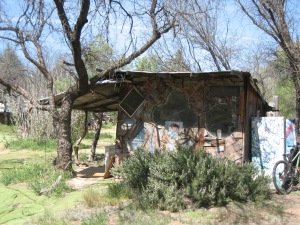
This is a photo I took of the Winter Palace, the first home of Michael Kahn, and his wife Leda Livant Kahn. They built it when they first moved to the Cornville area. This is a side view. The entrance is under the awning. The space is a gallery of sorts, as it houses items for sale made by artists associated with Eliphante. The one-room building is very tiny, and I told my guide that I can imagine living in such a small space alone, but not with another person, even another person I loved very much.

After I signed the liability waiver, I was on my own to walk around and look around and poke around. I put my camera in my pocket and went exploring.

The first building I explored was the Hippadome.
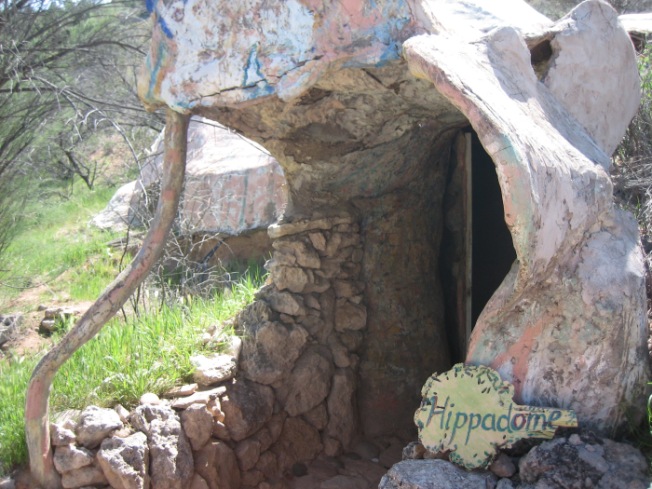
I took this photo of the front entrance of the Hippadome.

I took this photo of the front entrance of the Hippadome.

When I walked in, there were several people sitting around in the main room of the dwelling. I was greeted by Leda Livant Kahn herself. Wow! What a wonderful person. She told me later that she was born in 1925, and met Michael Kahn in 1979, at which time she left her husband of 24 years and her nearly adult children. (One child was a freshman in college and the other was a senior in high school.) She was 54 when she started the new chapter of her life with Michael Kahn, which definitely gives me hope for my later years.

The folks in the Hippadome were preparing to leave when I arrived, so I soon had the place to myself. I explored the many little nooks and crannies and took several photos.
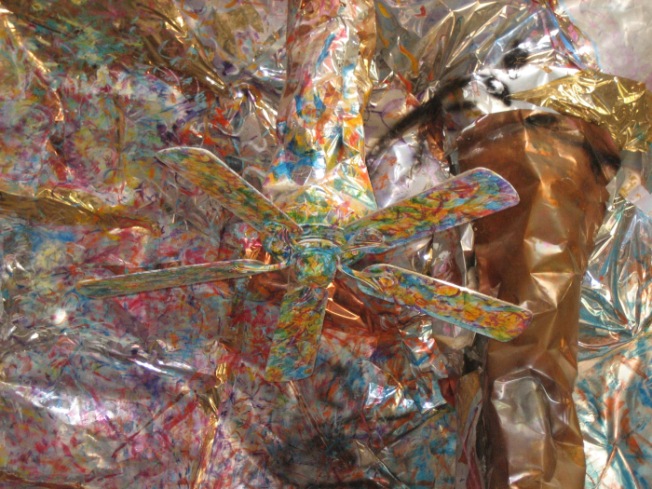
Can you find the ceiling fan in this photo I took? The walls and ceiling of the main room were covered in some sort of metallic paper (I think) and then painted in bright colors. In the middle of the floor, under the floor covering was some sort of soft, comfy material.

Can you find the ceiling fan in this photo I took? The walls and ceiling of the main room were covered in some sort of metallic paper (I think) and then painted in bright colors. The ceiling fan was painted to match.
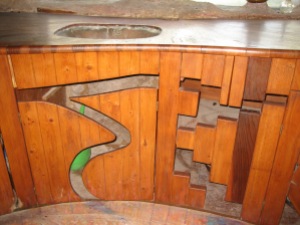
This is the sink area in the kitchen. The doors to the cabinets under the sink are made of wood with cut out designs.

This is the sink area in the kitchen. The doors to the cabinets under the sink are made of wood.
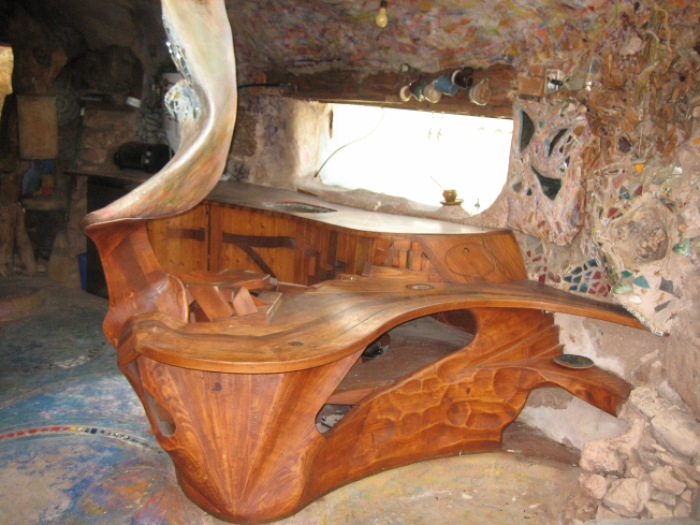
 This is a bar between the kitchen and a sort of nook area leading up to the common room/living area. The bar is made from ultra smooth wood that almost gleams in the light. Notice the floor in the kitchen area. Notice the mosaic wall next to the bar. I took this photo.

This is a bar between the kitchen and a sort of nook area leading up to the common room/living area. The bar is made from ultra smooth wood that almost gleams in the light. Notice the floor in the kitchen area. Notice the mosaic wall next to the bar.

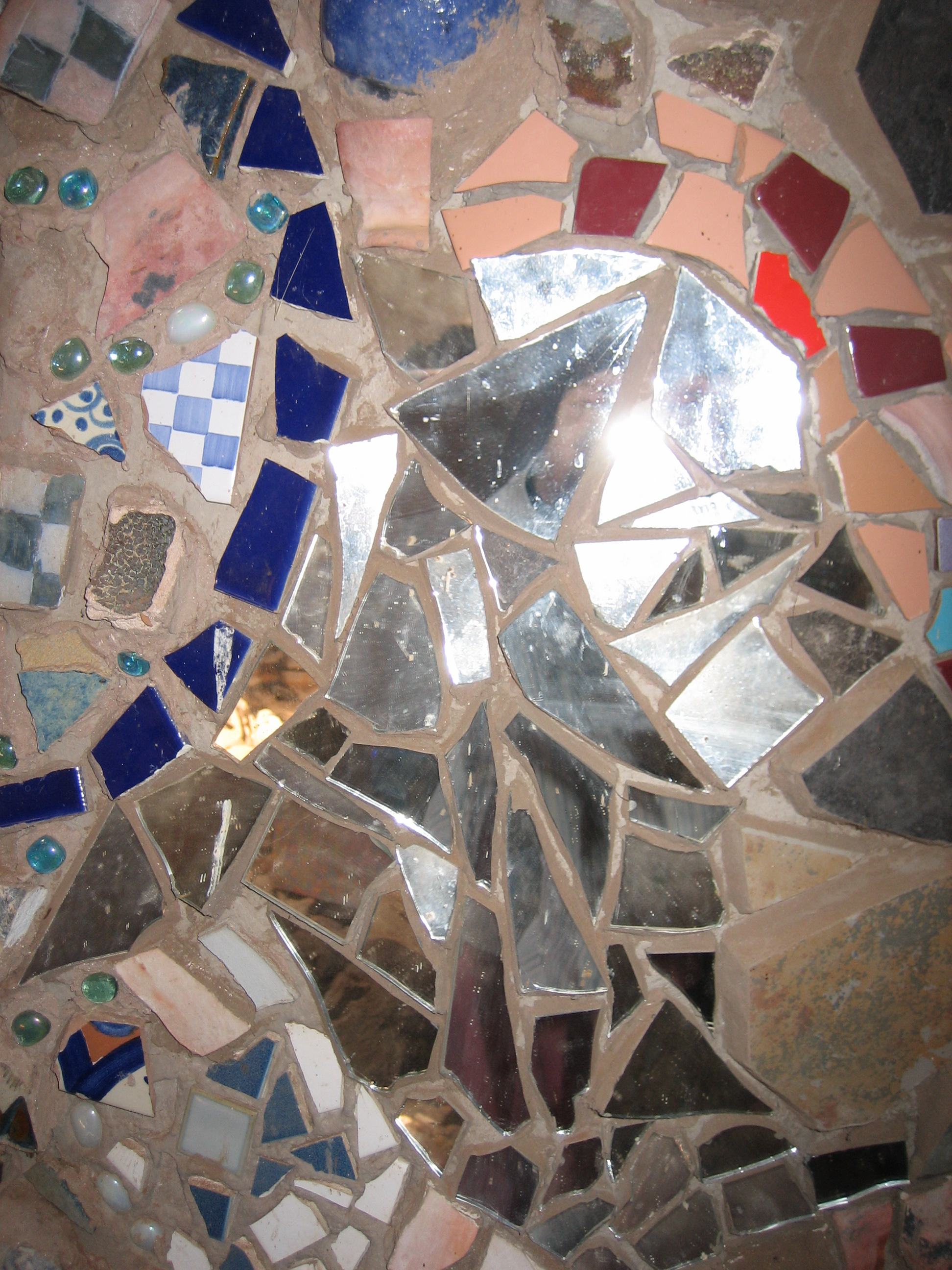
The next two photos were taken by me and are details of the mosaic on the wall next to the wooden bar.
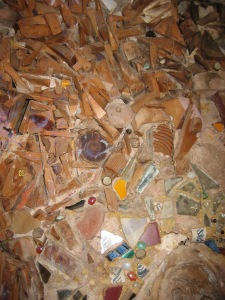
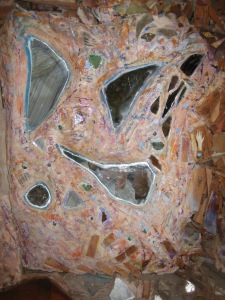
IMG_2477        IMG_2479

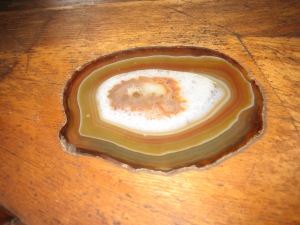
This photo (taken by me) is of an agate slice set in the counter top of the bar.
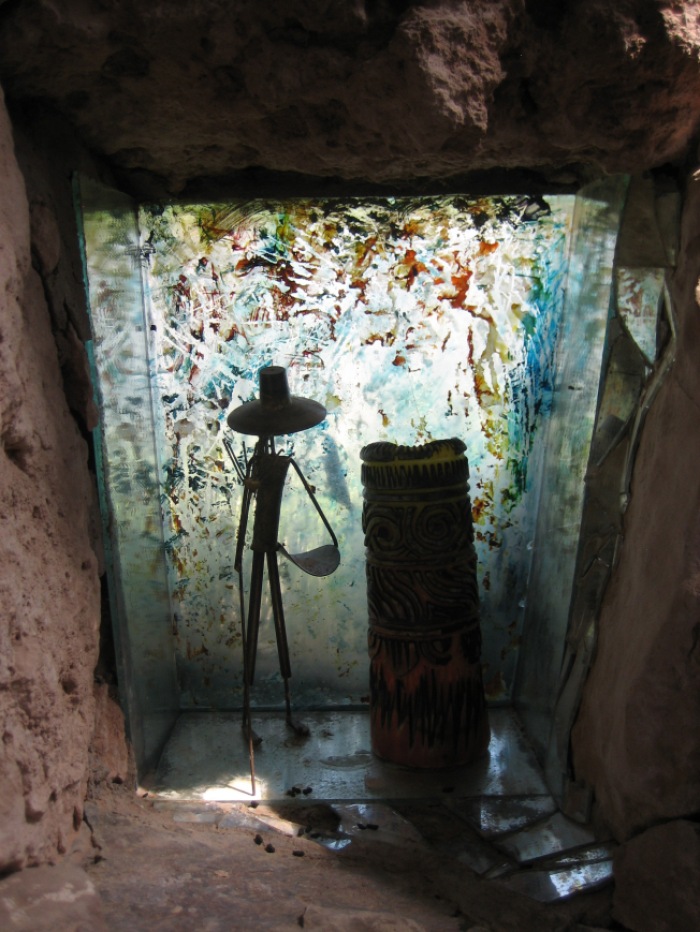
This photo is of an agate slice set in the counter top of the bar.

This was a nook in the wall with a "stained glass" windowing letting in light.

This was a nook in the wall with a “stained glass” window letting in light.

Ladder. Tiny door. Sleeping (?) loft.

The Hippadome has a second room, with a ladder and what I think is a sleeping loft. On the ground floor of this room were two desks, so maybe it was a work room too. On the second level, just beyond the ladder, there is a small door leading outside. I climbed the ladder up to the loft. That was a precarious endeavor. I thought better of it, but I really wanted to go through that small door, so I heaved myself up at the top. I should have taken my backpack off. I’m glad I didn’t fall.
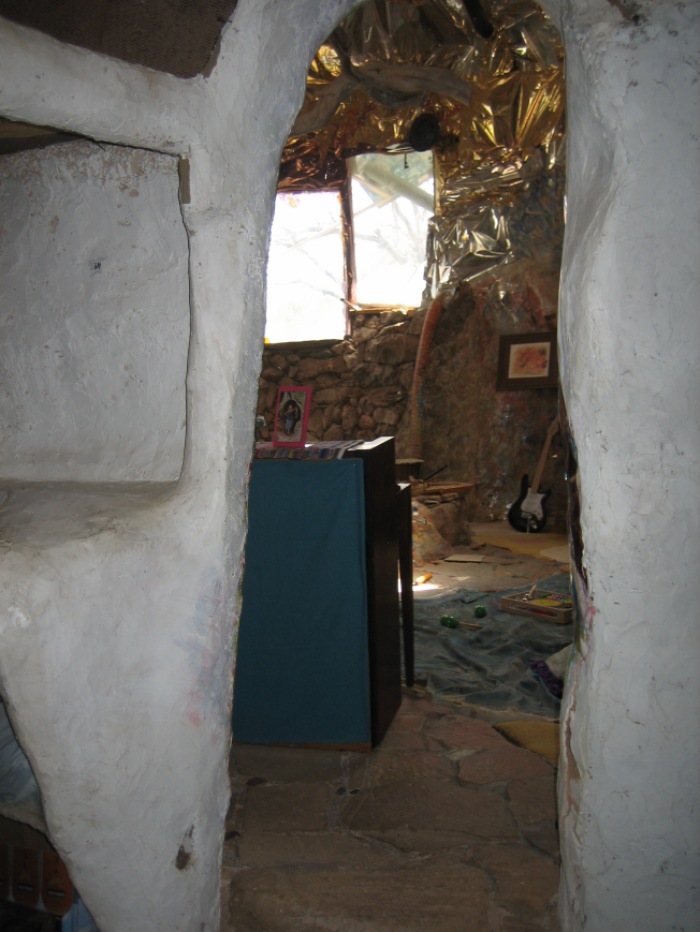
I took this photo from the loft room, looking back into the common/living room. The blue area in the middle of the floor is a cushy soft napping area. Some sort of bedding material has been set into the floor, at the same level as the stones, so there is a comfortable place to lie down. Notice that the walls under the windows are made of carefully stacked stones.

I took this photo from the loft room, looking back into the common/living room. The blue area in the middle of the floor is a cushy soft napping area. Some sort of bedding material has been set into the floor, at the same level as the stones, so there is a comfortable place to lie down. Notice that the walls under the windows are made of carefully stacked stones.

When I tried to go through the small door, I realized two things.

#1 Eliphante should add to the liability waiver that the institution has no responsibility if a person gets stuck trying to go through a door too small for his/her body. (Yes, I almost got stuck. Again, I should have taken my backpack off. Later Leda told me the door I went through had been the dog’s door.)
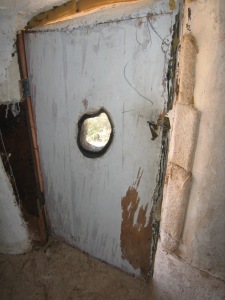
This is the tiny door in which I almost got stuck. I took this photo before I tried to cross through the portal.
This is the tiny door in which I almost got stuck. I took this photo before I tried to cross through the portal.

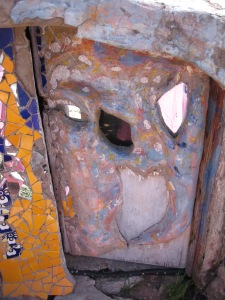
This is what the tiny door looks like on the outside. I took this photo after I extricated myself from the confines of the opening.

This is what the tiny door looks like on the outside. I took this photo after I extricated myself from the confines of the opening. Notice the mosaic to the left of the door.

#2 The Hippadome is built into a hill, because when I stepped through that door, I was standing on the ground.
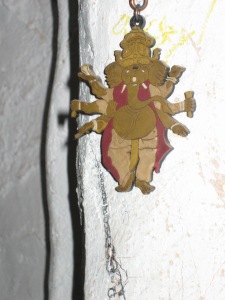
This was hanging on the wall, in the shadows in the loft room. I had to take this photo with the flash.
This was hanging on the wall, in the shadows in the loft room. I had to take this photo with the flash.

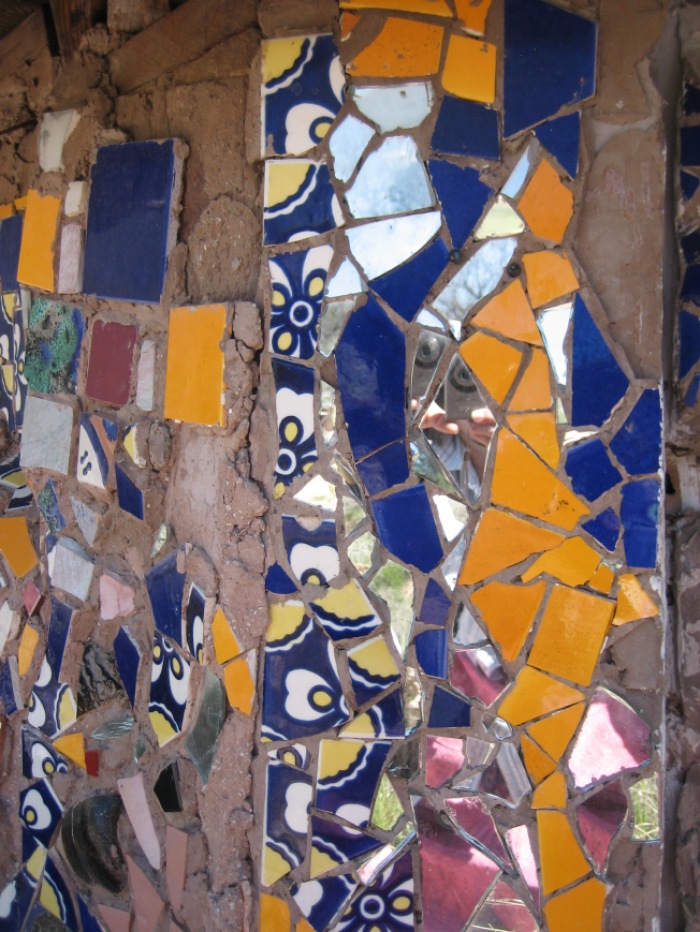
This is one part of the mosaic that covers one wall of the Hippadome. I took this photo.

This is one part of the mosaic that covers one of the exterior walls of the Hippadome.  It is to the left of the tiny door leading from the loft room to the outdoors. Can you see my fingers and camera in the mirrors? The pink on the lower right is not pink tiles, but the reflection of my pink skirt in bits of mirror.

To be continued at http://www.rubbertrampartist.com/2015/08/24/eliphante-part-2/.

All photos in this post were taken by me.

Newest Collages

Standard

I made these two collages in July. Each one is a postcard that I sent through the mail to two different friends.

I made this one first:

IMG_3212

The words on this one read: “Promise me you’ll always remember: You’re braver than you believe, and stronger than you seem, and smarter than you think.” It’s a quote from A. A. Milne, from one of the Winnie-the-Pooh books, I think.

I made this one second:

IMG_3263