Tag Archives: California

World’s Largest Thermometer

Standard

Do you know where the world’s largest thermometer is?

IMG_3482

If you looked closely at the above photo, you’ve probably guessed it’s in Baker, California. You’ll also see that Baker, which is close to the Nevada border, calls itself the “Gateway to Death Valley.”

IMG_3484

According to Roadside America,

The World’s Largest Thermometer is a 134-foot-tall symbol of the record high temperature in the U.S., in nearby Death Valley — 134 degrees Fahrenheit in 1913.

I’d heard of this thermometer before, but I thought it was in Needles, CA. (I don’t really know why I thought it was in Needles.) I had no idea I was going to see it as I drove from Barstow to Las Vegas, but there it was, rising out of the desert. I decided to pull over and see it.

It was still early in the day (around 11am, I think) and only 91 degrees. I wanted to see that sucker lit way up, but it wasn’t hot enough for that.

Here’s the history of the thermometer, from the aforementioned Roadside America Article

Willis Herron, a businessman, dreamed of a huge thermometer for 25 years before he made it real in California’s high desert.

The site chosen for the thermometer was along the main drag through town [Baker], visible from the interstate. In 1990 Herron paid to have the thermometer constructed by Young Electric Sign Co., manufacturers of many neon and bulb monstrosities on The Strip in Las Vegas. 33 tons of steel and almost 5,000 lamps went into the three-sided digital display.

But strong winds broke the thermometer, smashing a gift shop under construction. Herron, undaunted, had the thermometer rebuilt, filled with concrete…

Herron died in 2007. In 2012 the Baker thermometer stopped working and was put up for sale. Its owner blamed its shutdown on a bad economy and a thermometer-topping monthly electric bill. In 2014 the thermometer was purchased by Herron’s daughter, and his widow paid to repair the thermometer; it was officially turned back on Oct. 11.

Willis Herron’s decision to build his thermometer 134 feet tall has proved to be just tall enough, as the highest temperature it’s recorded was 127 degrees in August 1995.

When I pulled off of I-15 at exit 246, and drove through Baker to get as close as possible to the attraction, I felt as if I had been there before, although I didn’t have any memory of the thermometer. I thought maybe Baker was the place where Mr. Carolina, Sweet L, Robbie, the Fighting Couple, and I  slept the night we left Las Vegas. However, as I drove through town, I didn’t see where we might have parked or where everyone would have gone after piling out of my van. Maybe we slept at a rest area somewhere right outside of Nevada and then went to Baker in the morning? If we did stop in Baker, it was only for a short time, but how could I have forgotten about seeing the world’s largest thermometer? The workings of my memory is very mysterious.

In any case, now I know I’ve seen the thermometer, and I have photographic evidence to prove it.

Three Bears (Part 2)

Standard

I’d recently seen my first California bear, and more bear activity was reported in the campground in the next few weeks.

Some young Forest Service employees staying in the campground while investigating predator (weasel) populations in the area left their ice chest outside their truck overnight, even after we (casually) discussed how bears have learned that ice chests harbor good eating. (I’ve been told that if an ice chest musts be left in a vehicle, it should be covered so bears can’t identify it. Bears have broken into cars to get to ice chests inside. The safest way to store food in bear country is probably in a bear canister.)

The Forest Service employees reported they’d heard bear-type noises in the night, so the woman left her tent to investigate. By the time she’d exited the tent, the bear had run away , and everything in the campsite looked fine. However, when they got to the area where they were performing their investigation and opened the ice chest to pull out the raw chicken used to entice the weasels, they found the cooler empty! The bear in the campground had eaten six chicken halves, then quietly closed the lid of the cooler and scurried off before the woman made it out of her tent.

One morning right before I was laid off, a couple reported a bear had been in the area near their tent the night before. They heard the bear trying to get into the (bear-proof) garbage cans, then rolling logs around. By that time, summer had moved into fall, and the bear must have been hungry in preparation for its long winter nap.

I guess I went to bed too early or slept too deeply or maybe just didn’t leave enticing food lying around, because I never heard any bear activity in the night.

I saw bears #2 and #3 on the same evening. I was driving the company truck to the parking lot to retrieve the self-pay envelopes from the iron ranger. I left before dark, but the sunlight was quickly fading as I twisted and turned through the mountain road curves.

Suddenly an animal was crossing the road not too far ahead of me. What was it? It was too large to be a coyote or a wolf. Was it a mountain lion? Then it was fully out in the road, and I realized it was a bear. A bear!

I’d stopped the truck in the middle of my lane (traffic wasn’t really a concern at that time of night at that time of year) and watched it amble across the road. A bear! I was hooting and hollering and pounding the steering wheel. A bear!

This bear was much better looking than the Tom Waits song bear. This bear was black, with shiny, smooth fur. It was smaller than the other bear and seemed to have more energy. I watched it cross to the other side of the highway and disappear into the trees.

I saw the last bear on my way back to the campground. It was almost dark by that time, and the bear was little more than two glowing eyes and the shadow of ears in the trees next to the highway.

I got my wish. I saw bears, from a distance and in relative safety. All of them, even the one with the shabby coat, were awesome to behold.

To read more of my stories about bears, go here: http://www.rubbertrampartist.com/2015/04/15/my-first-bear/, here: http://www.rubbertrampartist.com/2015/05/28/bearanoia/, and here: http://www.rubbertrampartist.com/2015/05/11/kids-and-bears/.

Image courtesy of https://pixabay.com/en/black-bear-portrait-head-face-1019046/.

Three Bears (Part 1)

Standard

I spent part of the spring and the whole summer in the National Forest, but I didn’t see a bear until it was almost time to leave.

I don’t know why bears didn’t come into my campground. I don’t know where they were hiding, but I didn’t see any until September, after I moved back to the larger campground.

I didn’t see (or hear) the bear who scratched on the back of a toy hauler, but the campers told me all about it the next morning. They’d awoken around midnight to the sound of scratching on the their RV. At first the woman thought their dog was making the noise, but that proved to not be the case. When the man when out to investigate, he found a bear trying to open the back ramp door. The couple had cooked in the kitchen inside the RV, and the bear was probably enticed by the lingering food odors. The bear was smart enough to figure out which part of the trailer opened, but was not (yet) smart enough to figure out how to open the latches keeping the door closed. The man chased the bear away by shouting at it, which worked because the bears in the area are very timid and afraid of people.

The attempted bear invasion happened on Thursday night. I scared several campers over the weekend when I told them about the bear in the campground. As I told a group of (so very) young women, I wasn’t trying to scare them. I just wanted them to have as much information as possible to stay safe.

Here are my bear safety tips:

#1 Keep all food in bear-proof boxes or in a vehicle with locked doors and closed windows. No food in tents!

(If you’re back country camping in bear territory, you really need to keep you food in a bear canister.)

#2 If a bear is in your campsite, chase it away. Make yourself as big as possible. Yell at it. Make a lot of noise. Throw rocks at the bear if you have to. Let it know it’s in your territory.
#3 If the bear already has your food, don’t try to take the food back.

#4 Don’t run from a bear! The bear might chase you, and the bear is faster than you are.

Bears can run more than 60 kilometers [37 miles] an hour…more than twice as fast as we can run, and they can do it up hills, down hills or along a slope.

#5 Don’t think climbing a tree is going to save you.

Despite all their timidness on the ground, black bears seem to feel more courageous in trees. Bears sometimes kill each other by throwing their opponents out of trees. The bear below has the advantage because the bear above cannot easily hang on and face downward to fight back.

On my next day off, I planned to go to the post office/WiFi spot nine miles away to pick up my mail and catch up on my internet work. I planned to leave as soon as the sun was up so I could get an early start.

When I tried to start the van–disaster! The battery was dead.

I saw some campers had arrived during the night, but no one was stirring on the campsite. I decided to make the two minute walk to the highway and flag down a driver and ask for a jump start.

The highway was slow around 7am on that Tuesday. (By “slow” I mean no vehicles whatsoever.) I paced as I waited to hear an engine coming around the curve.

I glanced over to the north and saw movement, something headed in my direction.

My brain fills in the blanks of the world around it in strange ways. I swear, my  first fleeting thought was to wonder whay that man was wearing that crappy bear suit and walking on the side of the road.

Then I said out loud, Oh shit! That’s a bear!

The bear was brown in color (although in California, all wild bears are technically black bears, no matter the color of their fur). The bear looked like it was having a rough morning, a rough life. I know I’m anthropomorphizing here, but the bear looked tired and possibly hung over. The bear looked like a bear in a Tom Waits song (if Tom Waits sang about bears).

The bear’s coat looked shabby and dull, as if it had been worn too long or retrieved from a dusty attic, or maybe picked out of a free box on the outskirts of skid row. The bear was lumbering along slowly, on all fours, on the dege of the road, as if it just didn’t have the energy to climb the hill into the forest and pick its way through the trees.

Bears don’t like crashing through bushes any more than people do, and are often found on trails, especially early in the morning, near dusk and at night. – Linda Masterson in Living with Bears (pg 177)

The bear was about as big as a medium-size man, which added to my snap conclusion that I was seeing a worker from a down-and-out carnival too tired to remove his shoddy costume at the end of a long night.

But then I realized I was actually seeing a bear, a bear that was walking toward me, and I felt a little panicked.

The bear was maybe 100 yards from me. (I’m really bad at estimating distances, so I’m not sure.) It was moving toward me, albeit quite slowly.

I decided I did not want the bear to think I was trying to invade its territory, so I scurried across the road and into the large driveway leading into the campground. Once i crossed the street, I could no longer see the bear, but after only a few moments, I heard crashing through the trees. I walked back to the edge of the driveway and peered down the road. The bear was gone.

That was my first California bear sighting, but it wasn’t my last bear experience.


Images courtesy of https://pixabay.com/en/black-bear-walking-wildlife-nature-1901957/and https://pixabay.com/en/bear-cubs-animal-black-tree-branch-50137/.

Toilet Paper Hero of Hoover Dam

Standard

IMG_3567I first learned  of the Toilet Paper Hero of Hoover Damn while reading a back issue of Sunset magazine.

I was delighted to learn the statue won the Reader’s Choice Award for the West’s Most Outrageous Roadside Attraction, beating out The Mystery Spot in Santa Cruz, CA; the 22 foot-in-diameter donut atop the Randy’s Donuts building in Inglewood, CA; Spuds Drive-In Theater (complete with a “two-ton tater sitting in the bed of a candy-apple 1946 Chevy truck”) in Driggs, ID; the International UFO Museum in Roswell, NM; and the Hole n’ the Rock in Moab, UT.

At the time I read the the short blurb about the Toilet Paper Hero, I had toilet paper on my mind.

I was a camp host in a National Forest, and one of my duties was the upkeep of restrooms.

If, when you think of restrooms, your brain conjures images of flush toilets and sinks with running water and soap and paper towels nearby, you are not thinking of my campground restroom experience. The campground I was hosting had pit (also called “vault”) toilets. Nowhere in my campground nor in any other public campground on the mountain was there running water. The toilets I maintained didn’t flush, and there were no sinks, no soap, no paper towels.

In my five months as a camp host, I cleaned human feces off restroom floors and walls, chased a family of mice from a restroom, and dealt with a lot of toilet paper. I immediately knew that the Toilet Paper Hero was my kind of working class champion.

I was excited to see the Toilet Paper Hero was associated with the Hoover Dam. I’d been to the Hoover Dam, and I knew it was close to Las Vegas, NV. Since I was planning to visit friends in Vegas when I left California, I decided I’d make a pilgrimage to the home of the Toilet Paper Hero in Boulder City, NV.

I left Vegas by 7am on Saturday morning. I’d planned my route in advance, but had not been able to find an exact street address for the statue, nothing that was easily plugged into Google Maps. All I knew was that I had to take US 93, then turn onto Nevada Way and drive into downtown, looking for the corner of Nevada Way and Ash/Wyoming Streets. (Directions courtesy of http://www.roadsideamerica.com/story/23150.)

I almost chickened out. I came to a fork in the road where I had to decide if I was going to go into the unknown (AKA downtown Boulder City) or just bypass the town and head toward the Hoover Dam and onward to Arizona. Since I wasn’t 100% sure of my directions, I was a little nervous. What if I got lost? What if I made a fool of myself?

Oh, come on! I chastised myself. You can do this! It’s the Toilet Paper Hero, for goodness sake. You’ve been looking forward to this for months.

So I did it. I found the Hero and made his acquaintance and took some photos.

IMG_3551

This is the informational plaque which stands next to the Hero.

The statue was created by artist Steven Liguori. According to http://www.roadsideamerica.com/story/23150,

In 2007, Boulder City commissioned local artist Steven Liguori to immortalize “Alabam,” one of the unsung workers who helped to build nearby Hoover Dam.

Steven had earlier sculpted a heroic-size statue of a high scaler, one of the Dam’s most glamorous and exciting workers. But he felt that the unseen people of Hoover Dam deserved to be honored, too. When Boulder City launched a project for public art, Steven submitted his proposal for a statue of Alabam. The city, to its credit, accepted it.

Steven sculpted Alabam as he looked in old photos from the 1930s. The eight-foot-tall bronze statue — mixed with copper salvaged from the Dam’s electrical grid — shows Alabam wearing a fedora, overalls, and thick gloves, with a broom slung over his shoulder like a combat rifle, and a large bandolier of toilet paper rolls strapped across his chest. The man definitely had a sense of style.

IMG_3554Alabam was unveiled on a Boulder City street corner on June 29, 2007.

The same website says,

Alabam was a specialist. His job was to clean the outhouses of the vast construction site: sweeping refuse, tossing lime into holes, and restocking the always-diminishing supply of toilet paper.

Not much is known about Alabam. He was among the older workers. “Maybe his name was John or Bill, but there were lots of Johns and Bills at the Dam,” said Steven. “He was probably from Alabama, so they called him ‘Alabam’.”

IMG_3553In a job site filled with draftsmen and construction designers, Alabam referred to himself as “the sanitary engineer.”

“Alabam’s role might not seem important, but it was,” said Steven. Workers would start the day with a big breakfast at the mess hall, then pack a big lunch to take to the construction site. “But once you got to the Dam, you were stuck there all day.” The outhouses got used — a lot.

“Can you imagine cleaning latrines for 7,000 men in 120 degree heat?” Steven asked. “Can you imagine the smell? Oh my god!”

I really love that this statue is a based on a real person with a real personality, a man who had the sense of humor and the sense of his own worth to call himself “the sanitary engineer.” It would be a cool piece of art if it were a fictional representation of all the men who cleaned outhouses at the building site of the Hoover Dam. However I like it so much more knowing it is based on an individual, a real person who, like me and my co-workers, lived and breathed and sweated and was dirty at the end of the work day.

IMG_3557

I’m glad I overcame my silly little fear of the unknown and stopped by to visit with Alabam.

IMG_3572All photos in this post were taken by me.

Dome Rock

Standard

This is Dome Rock, seen from a distance.

IMG_3397

According to http://www.summitpost.org/dome-rock-ca/153955, Dome Rock “is a 400′ high by 800′ wide granite monolith.” It is located on the Western Divide Highway, between Quaking Aspen campground and the Trail of 100 Giants. Dome Rock is located at the end of Forest Service Road 21S69, which is directly across from the Peppermint Work Center.

I’d heard of Dome Rock for several weeks before I visited it or even saw it from a distance. I wondered what the big deal was. It was just a rock, right? What’s so exciting about a rock?

The afternoon I visited, I drove down the short dirt road, excited to see something new.

The dirt road ends in a wide area for parking. I wasn’t sure how exactly to get to Dome Rock, but I saw a green gate with a sign on it.

IMG_3008

This is the sign I saw posted on the green gate.

I decided the rock must lie behind the gate. I walked behind it and headed up to the top of Dome Rock.

It’s not really a hike to the top of Dome Rock. I saw a faint trail and followed it up. The climb was a little steep, but not too difficult, even for an inside kid like me. The climb was absolutely nothing as intense as the climb to the top of Moro Rock in Sequoia National Park. (To read that story, go to http://www.rubbertrampartist.com/2015/08/02/i-climbed-it/.)

When I got to the top of Dome Rock, I realized the attraction is not the rock itself, but the view from the top of the rock. The view was amazing. Here’s a photo of mountains in the distance.

IMG_3021

Of course, the photos my little camera produces don’t really do justice to what in real life is a fantastic view.

Here’s a view of more mountains in the another direction.

IMG_3028

Are one of these peaks Mt. Whitney?

Mt. Whitney is apparently visible from the top of Dome Rock. According to Wikipedia, “Mount Whitney is the highest summit in the contiguous United States and the Sierra Nevada, with an elevation of 14,505 feet.”  I visited Dome Rock alone, so I had no one to point out Mt. Whitney to me. You’d think it would be easy to see the tallest mountain in the continental United States, but I didn’t see any mountain towering over all the rest.

Being on top of Dome Rock made me feel like I was on another planet. (I had that experience more than once in California.)

Dome Rock is so big that trees are growing on top of it.

IMG_3024     IMG_3010

IMG_3035

Pine tree on the top of Dome Rock.

Some of the trees on Dome Rock are dead.

IMG_3016     IMG_3022

IMG_3040

Someone had been up there stacking rocks.

IMG_3019     IMG_3017

Throwing rocks from Dome Rock is apparently a really bad idea. There’s another sign up there saying not to do it.

IMG_3026

The next photo shows that there are no guardrails around the edges of Dome Rock.

IMG_3023

See the edge there where it looks like the rock just ends? It really does! There’s no more earth on the other side of those rocks, just air and a loooooong drop.

According to a Forest Service informational brochure (which can be seen at https://fs.usda.gov/Internet/FSE_DOCUMENTS/fsbdev3_058930.pdf) visitors should “… be aware that there is no guard rail and the slope of the top of Dome Rock may be deceiving, with the drop to the bottom being hundreds of feet. Parents of young children should hold them securely while visiting the top.”

I scurried around the edge, wondering how close was too close. I suppose I didn’t get too close, as I didn’t plummet the hundreds of feet to the bottom.

It was very peaceful on the top of that rock. No other people where out there with me, and I didn’t hear a single sound produced by a human other than my own footsteps and breathing.

IMG_3388I didn’t stay on Dome Rock for very long. I hadn’t worn my hat, and the sun was beating down on my head. I enjoyed my visit and was glad to see a new outdoor attraction.

I took all the photos in this post.

a Little Matter with a Bridge in San Francisco

Standard

In the autumn of 2012, I was traveling in California with my friend Mr. Carolina, and there was a little matter with a bridge in San Francisco.

Mr. Carolina was driving my van, and he thought he was taking the way which would save us the toll. We literally had no money to give to any nice toll collector, so he was trying to avoid them. We saw the “last exit before toll” signs, but it was just one of those driving moments when you don’t know what exactly to do, so he just kept forging ahead. When we got to the toll booth, he very sweetly explained to the lady that we didn’t have any money to give her. (With Mr. Carolina’s Southern accent, who knows, really, how much of what he says any stranger understands? I spent a majority of my time with the man for two months, and even at the end I would sometimes have to tell him I had no idea what he was saying.)

The toll booth worker had a pre-printed card for just such an occasion. We were not the first to arrive at that bridge with no money in our pockets. The card said I would be charged $25, which would increase to $70 if I did not pay up in a timely fashion. I put it out of my mind, deciding I would deal with it when I got a bill.

I expected to have a bill when I (finally) got to Austin, but there was nothing waiting for me. I was out of touch with the woman who was checking my PO box in Taos, but when I got in contact with her, she reported she’d found no letter from the state of California in my box. I told Lou the whole story, and she encouraged me to find out what the status was while still in Austin. Maybe it fell through the cracks, my mailbox checker suggested, but I didn’t expect to be that lucky.

Finally, I told myself I just had to deal with it. If Cali was asking for $70, I would try to talk them down to $25 since I had never gotten a notice in the mail. If they insisted on $70, I would ask for a payment plan. If I decided not to pay them, it would at least be a conscious decision and not just an avoiding of the situation.

The woman I spoke to on the phone was polite and efficient. What was my license plate number? When had the situation occurred? It happened in October and I had still not received a notice? That was strange. I should have received a notice by now. (By this time it was January.) Well, there was nothing in her system. Not a thing. My license plate number did not come up. No record of any toll violation. I could call my department of motor vehicles, but nothing showed up in her system and if there was a violation, it would be in her system. I said thank you very much and hung up the phone feeling quite relieved.

I think the toll booth worker was an angel who let us go on our way toward Northern California. Or maybe it was Mr. Carolina’s bubble of safety that protected us once again. In any case, thank you angels, bubble, kindness of tollbooth worker stranger, whatever saved me from giving my money to the state of California.

South Creek Falls

Standard

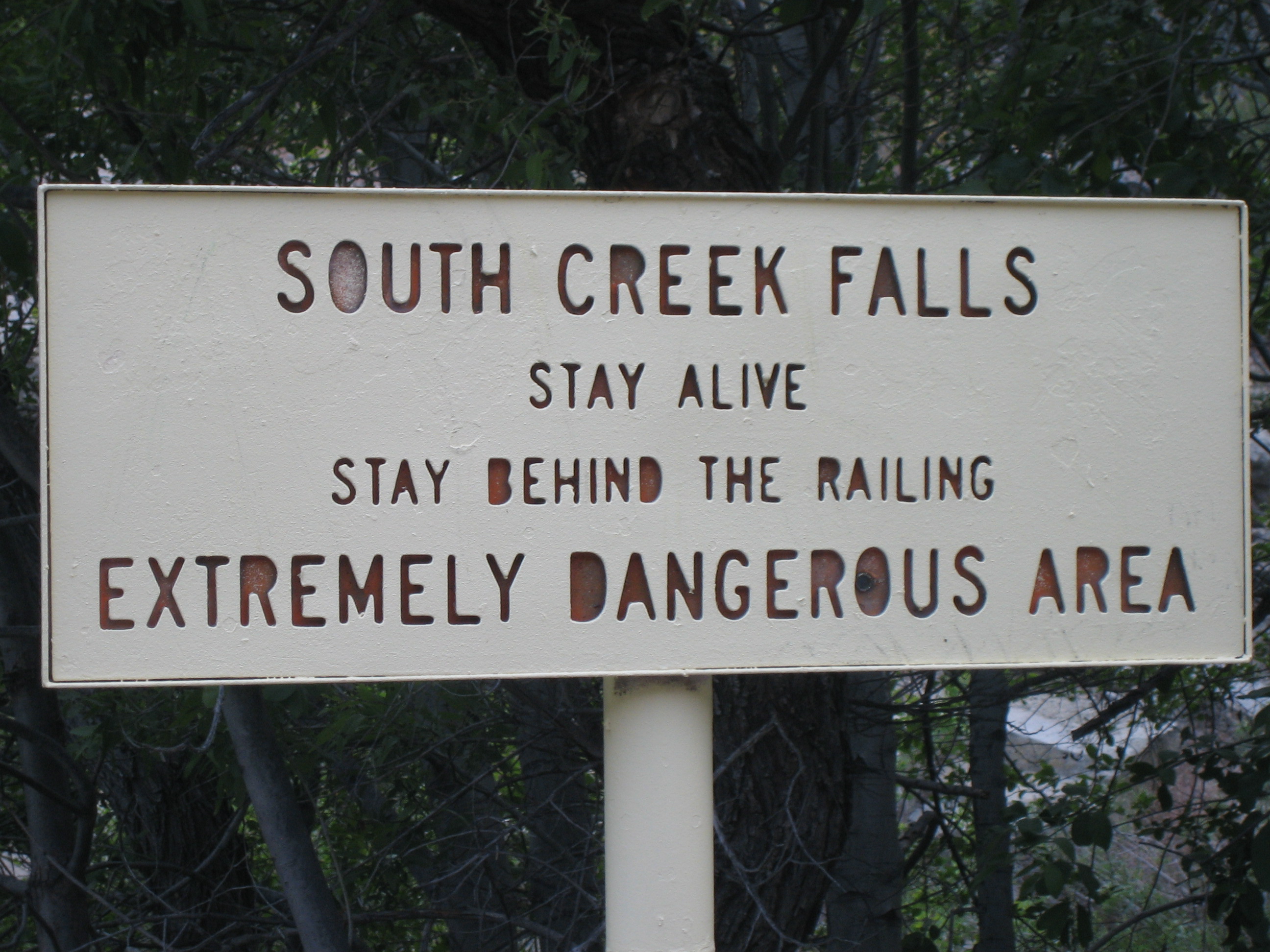
IMG_2980I really like the way this warning sign basically says, “Cross the barrier and you WILL DIE!”.

However, the barrier is mostly psychological. Anyone could take a short stroll to where the fence ends and step right behind it. I guess that’s why the sign is so serious. IMG_2998

IMG_2988

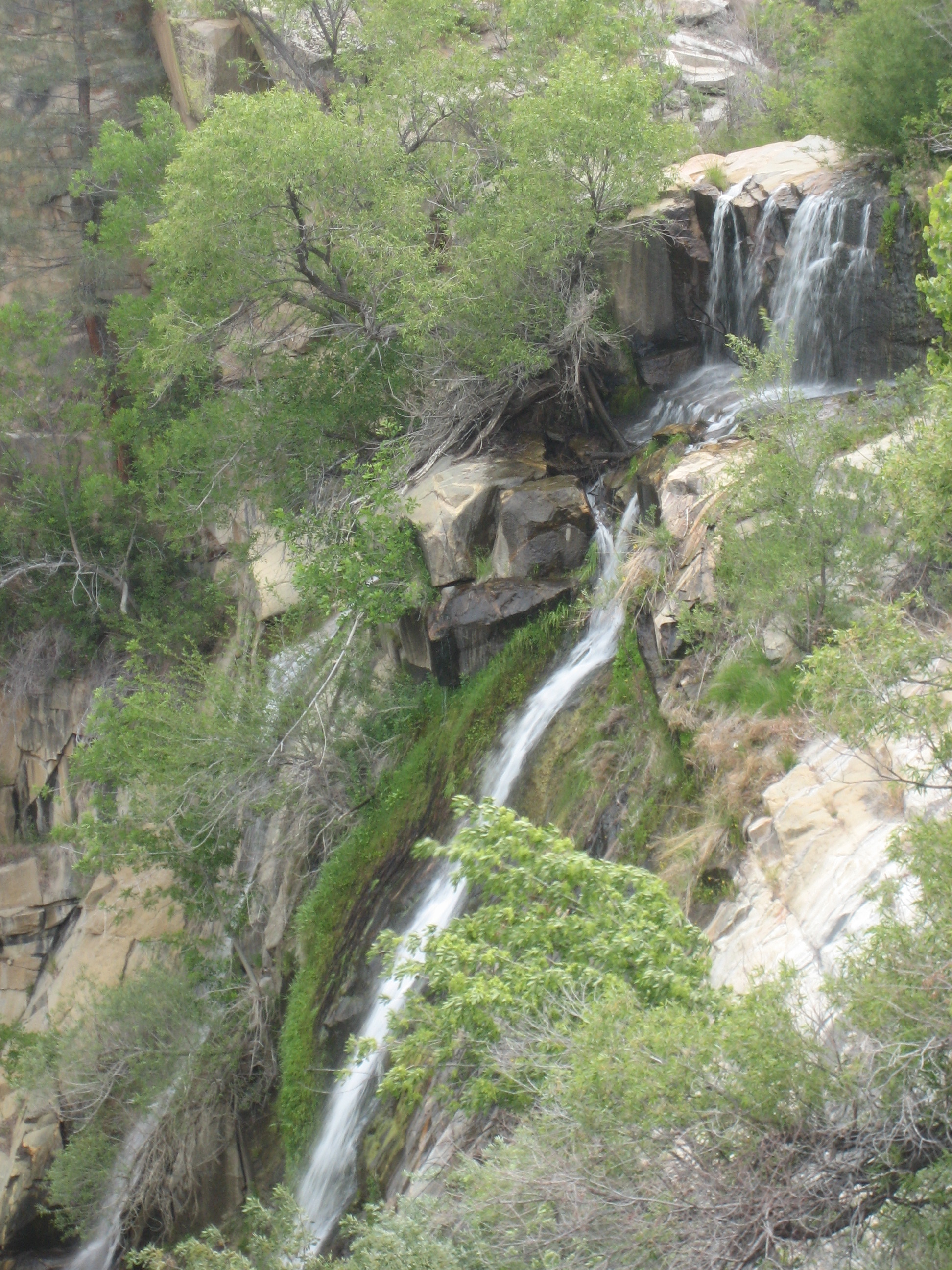
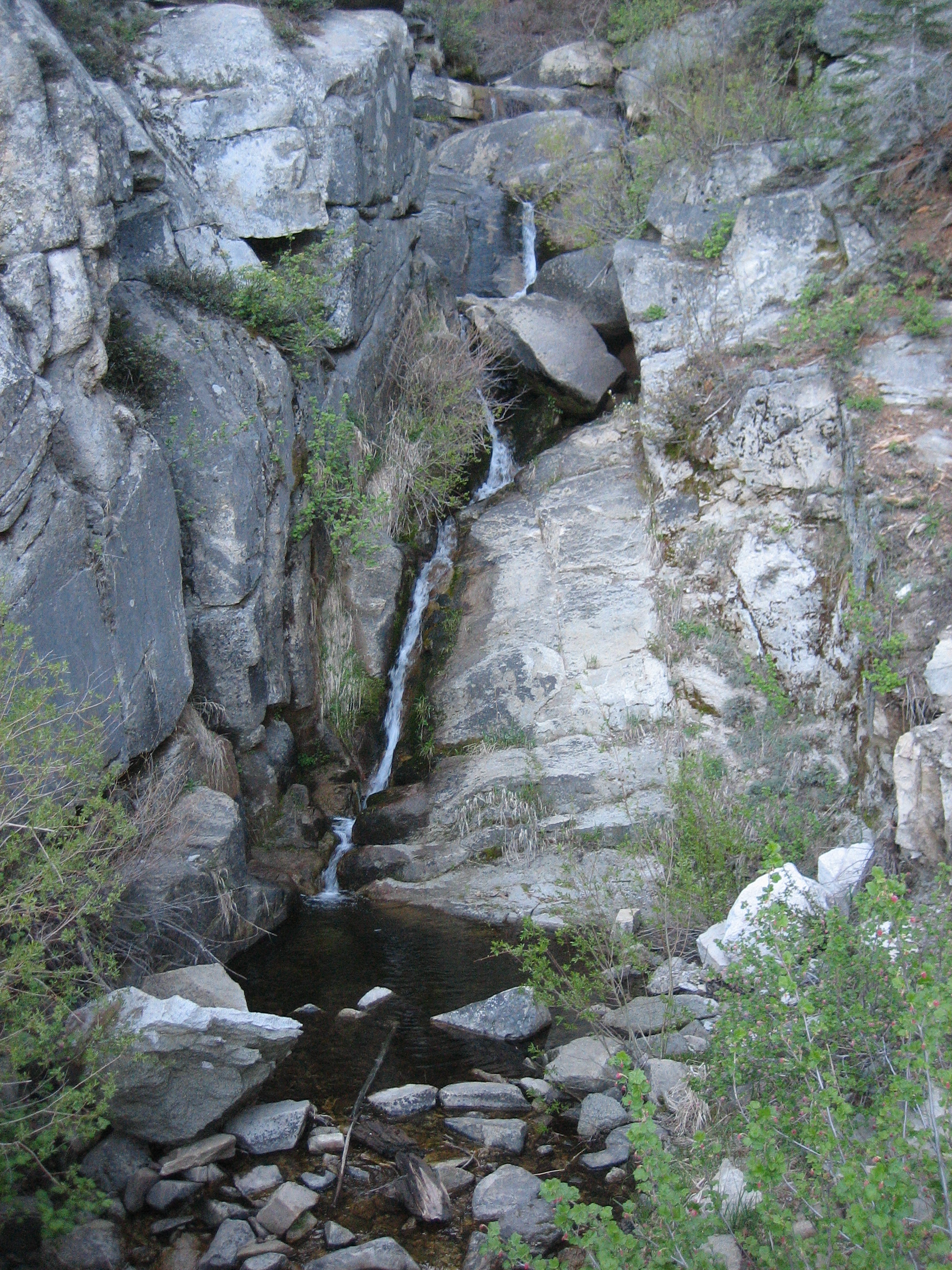
The first time I saw the falls, the water was flowing fast and heavy. However, when I took these photos (in May or June of 2015), the flow had slowed quite a bit.

IMG_2992     IMG_2995


IMG_2999

This photo shows the view from South Creek Falls:

I took all the photos in this post.

The General Sherman Tree

Standard

The main reason I decided to visit Sequoia National Park was to see the General Sherman Tree for myself.

For weeks I’d been answering visitors’ questions about the location of the General Sherman Tree. No, the General Sherman Tree is not here. It’s in the Sequoia National Park. It’s about three hours away.

A lot of people wanted to see the tree, and I wondered what the fascination was. At first I chalked it up to the American obsession with superlatives. We want to say we saw the biggest, oldest, tallest, heaviest. But it wasn’t just Americans who asked about the tree, and I got curious. What was it about the tree that caused so much interest?

I first saw the General Sherman Tree from a distance. Even from a distance, the tree is obviously big.

The General Sherman Tree from a distance.

The General Sherman Tree from a distance.

However, the General Sherman Tree lives in the Giant Forest. There are big trees all over the place. (Four of the five largest measured giant sequoias live within the three square miles of the Giant Forest, which was named by John Muir in 1875.)  I didn’t fully appreciate the tree’s size until I got close to it.

Close to the General Sherman Tree. It was difficult to get a shot of the tree without tourists standing in front of it. There was a nearly constant parade of people standing behind the sign so someone they were with could take a photo of them with the tree. I was alone and didn't want to ask a stranger to take a photo of me standing there, so I have no photo of me standing in front of the tree. You'll just have to believe I was really there since I have no photographic evidence.

Close to the General Sherman Tree. It was difficult to get a shot of the tree without tourists standing in front of it. There was a nearly constant parade of people standing behind the sign so someone they were with could take a photo of them with the tree. I was alone and didn’t want to ask a stranger to take a photo of me standing there, so I have no photo of me with the tree. You’ll just have to believe I was really there since I have no photographic evidence.

I don’t even know how to describe the size of the General Sherman Tree. Start with big and multiple by massive. Contemplate immense. Imagine tilting your head back, back, back in order to get a look at its crown, then keeping your head leaned back until it starts to cramp. I have no words to adequately describe the tree. And photographs? My little camera is certainly not capable of capturing the majesty of this tree.

Measurements of the General Sherman Tree were made by the American Forestry Association in 1975. Here’s what they reported forty years ago:

The height above the base of the General Sherman Tree was 274.9 feet.

General Sherman’s circumference at the ground was 102.6 feet.

The diameter of the tree’s largest branch was 6.8 feet.

The height of the first large branch above the tree’s base was 130 feet.

The General Sherman Tree is as tall as an average 27 story building. Its first significant branch is as high as the 13th story of such a building.

If the General Sherman Tree were placed in the middle of a California three-lane freeway, it would completely block all three 12-foot-wide lanes.

It’s ok if you can’t comprehend the tree’s size from reading these facts and figures. I stood right in front of the tree, looked up into the sky to see its crown, walked all the way around it, and I still can’t quite comprehend its size. It’s big. B.I.G. Did I mention massive? Have I used the word “enormous”?

IMG_3287

That really big log? That’s a branch from the General Sherman Tree that crashed to the ground some years ago. A branch!

There’s a wooden fence around the General Sherman Tree. It’s more of a psychological barrier than a physical one, since most folks in reasonable shape could easily get over the fence. It’s to keep an honest man honest, as my father would say. (Of course, at the Grand Canyon, a ranger had to give my father a stern talking to when Dad climbed over a wall that was obviously meant as a barrier. Perhaps the fence around the General Sherman would not keep my father and his ilk honest after all.)

This one's for Dad.

This one’s for Dad.

The fence is there to protect the General Sherman. It’s there to keep millions of visiting feet from compacting its root system and/or eroding the surrounding soil and exposing its shallow roots. It’s there to keep idiots from carving names and initials into the tree’s bark.

I understand why the fence is there, and i wouldn’t do anything to hurt the General Sherman, but I was a bit sad that I didn’t get to hug that tree. I did walk around the tree slowly, silently, trying to block out the chatter of the other visitors and feel the tree’s energy. (Luckily, I visited the General Sherman early in the day when there were relatively fewer people around.)

The other side of the General Sherman Tree. Notice the large fire scar.

The other side of the General Sherman Tree. Notice the large fire scar.

I’d like to be able to explain how it felt to be in the presence of a living being of such age and size, but really don’t have the words. I hope someday you can visit the General Sherman Tree and have your own experience.

Here's one more look at the General Sherman Tree.

Here’s one more look at the General Sherman Tree.

I took all of the photos in this post.

Much of the information in this post came from the booklet The General Sherman Tree by William Tweed. I picked it up for 99 cents at the Giant Forest Museum gift shop. It was money well spent.

To read more about giant sequoias and the Giant Forest Museum, go here: http://www.rubbertrampartist.com/2015/08/13/giant-forest-museum-and-the-sentinel-tree/.

Sequoias and Redwoods Are Not the Same Trees

Standard

One of the most frequent questions I am asked in the line of duty (meaning when I collect money in the parking lot) is What is the difference between a sequoia and a redwood? Related confusion is exhibited when visitors refer to the trees they are about to see/have just seen as “redwoods” or when people tell me they saw sequoias north of San Francisco. I feel it is my duty to correct such mistakes. The company I work for may see me as nothing more than a money collector, but I see myself as an educator.

When I visited Sequoia National Park, I bought an oversize postcard explaining the differences between giant sequoias trees and coast redwoods. The postcard’s copyright belongs to the Sequoia Natural History Association and has a date of 2009. I bought the postcard so I’d have something I could show folks in order to alleviate their sequoia/redwood confusion. As a service to my readers, I will summarize the information on the card (as well as information on a handout I was given by a Forest Service employee) and alleviate any confusion you may have regarding these trees.

The trees are in the same family, but we know they are not the same because they have different scientific names. The scientific name of the giant sequoia is sequoiadendron giganteum The scientific name of the coast redwood is sequoia sempervirens.

The easiest way to tall a giant sequoia from a coast redwood is location. While both grow naturally in California, coast redwoods live on the northern coast of California, and giants sequoias live on the Western slope of the Sierra Nevada mountains between 5,000 and 7,000 feet elevation.

(Instead of referring to where trees live, in the case of the giant sequoias, we must talk about where the trees occur naturally and/or reproduce. While reading the book Giant Sequoias by  R.J. Hartesveldt; H.T. Harvey; H.S. Shellhammer; and R.E. Stecker, I learned giant sequoias live throughout Europe, although the trees currently living there did not occur naturally—people planted the seeds the trees grew from—and the trees are not reproducing naturally there. I am unsure if coast redwoods grow—naturally or otherwise—anywhere other than the coast of California.)

Another difference between coast redwoods and giant sequoias is size. Coast redwoods are taller than giant sequoias. In fact, coast redwoods are the tallest trees in the world, reaching heights up to 367.8 feet. The tallest giant sequoia is “only” 311 feet. Giant sequoias, however, are wider, with widths up to 40 feet, compared to the widths of coast redwoods of up to 22 feet. Giant sequoias are the largest living trees; they contain a greater volume of wood than any other trees, due to their height and great width. Giant sequoias weigh up to 2.7 million pounds, while coast redwoods weigh up to 1.6 million pounds. Part of the reason for the weight and volume difference is the thickness of the bark of the trees. The bark of giant sequoias can be up to 31 inches thick, while the bark of coast redwoods can be up to 12 inches thick.

Both giant sequoias and coast redwoods reproduce by seeds, although coast redwoods can also reproduce by sprout. (Giant sequoias don’t reproduce by sprout.) Coast redwoods have seeds that look like tomato seeds, while giant sequoia seeds look like oat flakes. Both trees produce cones in which their seeds grow, but the cones are of different sizes. The cones of giant sequoia trees are about the size of a chicken’s egg, while the cones of coast redwoods are the size of an olive.

Giant sequoias live longer than redwoods. The oldest giant sequoia is thought to be 3,200 years old, while the oldest coast redwood is believed to be 2,000 years old.

Finally, all giant sequoias are protected by law from being harvested, while coast redwoods can legally be harvested and used for lumber.

So now you know the difference(s) between coast redwoods and giant sequoias. My work today is done.

I took this photo of a giant sequoia. Unfortunately, when I visited the coast redwoods, I didn't have a camera, so I don't have a photo of one of those magnificent trees to share.

I took this photo of a giant sequoia. Unfortunately, when I visited the coast redwoods, I didn’t have a camera, so I don’t have a photo of one of those magnificent trees to share.